About 4 years ago, in August 2022, an unmanned solar-powered drone called Zephyr, operated by the US Army and produced by Airbus, flew for 64 days, 18 hours and 26 minutes before unexpectedly crashing down in Arizona.
Whether they were trying to set the record for the longest continuous flight ever recorded, or not, one will never know, however what we do know that they were still 4 hours short of the record for the longest ever continuous flight.
That record was set in 1958-59 (yes, it actually started in 1958 & ended in 1959), by Robert Timm and John Cook, who flew a 4-seater Cessna 172 aircraft in the skies over & around Las Vegas for 64 days, 22 hrs and 19 mins, covering over 240,000 kms, which is the equivalent of flying six times around the earth.
Why did they do this?
It started as a flying billboard for the Hacienda Hotel, Las Vegas. The Hacienda Hotel and Casino had just opened at the southern end of the Las Vegas Strip, and its owners wanted to promote the hotel as one of the first family-oriented resorts in the city.
A slot machine mechanic of the Hacienda – Robert Timm, a WW2 bomber pilot himself, had an idea. Timm convinced the owner to fund (at an expected cost of US$ 100,000) an attempt to break the manned flight endurance record, with Hacienda Hotel featured prominently on the aircraft. He found a Cessna 172, registered N9217B, and with a trusted mechanic, spent a year modifying it for the record attempt.
The two made several changes to the 4-seater propeller aircraft. The most significant modifications included the addition of a fuel tank in the belly to supplement the 47 gallons carried in the wings. The 95-gallon belly tank had an electric pump to transfer fuel to the main tank, and they also replumbed the oil lines to change oil and filters without shutting down the engine. Further additions included a mattress to nap on, a small sink for personal hygiene, and a foldable camp toilet.
The problematic beginning
The first attempts to break the existing world record (of 47 days set in 1949) were unsuccessful. The longest of the first three failed attempts lasted just 17 days. In the meantime, another flying team who knew about this attempt, themselves set a new record of over 50 days.
Following some incompatibility issues with his co-pilot, Timm found a new co-pilot and mechanic in John Wayne Cook.
The record-breaking flight
The record-breaking attempt had the two take off on December 4th, 1958, at 15:52. They first made a low pass on the airfield to allow a chase car to paint white stripes on the aircraft’s tires to ensure they didn’t make any secret landings. The paint would scuff upon touchdown, and the resulting marks would be visible when “officially” landing. They spent most of their time flying over the deserts around Las Vegas, sometimes diverting to Los Angeles for TV promotional opportunities.
Refuelling
Now for the really ingenious method of refueling. Twice daily, a truck fitted with a fuel tank and pump would rendezvous with the aircraft over a straight stretch of closed highway along the California-Arizona border.
The Cessna would fly roughly 20 feet off the ground and use an electric winch to lower a hook and snag the refueling hose. Timm or Cook would stand on a platform outside the door and insert the hose into the belly tank, taking around three minutes to fill. Over the course of the flight, they refueled 128 times.
Food, Water, etc.
Food & water was provided complements of The Hacienda, which prepared gourmet meals. Some of the magic of the quality food was lost in transit, as the food had to be chopped up and stuffed into thermos jugs to get up to the pilots.
Bathroom breaks happened on a foldable camp toilet and the resulting plastic bags were later thrown out over the desert. An extendable platform on the co-pilot side provided more space for shaving and bathing A few litres of water was also sent up on a regular basis for them to wash / clean / bathe themselves every other day.
Problems
Thirty-nine days in, the generator failed, so they had no lights, heat, or fuel pump. The pair relied on a hand pump to pump fuel from the road to the plane. Since the plane had no lights, oftentimes they had to refuel at night in near-dark conditions, except for the moon or the headlights of the fuel truck or torches carried by the refuel crew.
Sleeping was difficult even with the mattress due to the engine’s noise and the plane’s vibrations. At one point, Timm fell asleep while flying for over an hour, and the aircraft was kept aloft thanks to a rudimentary autopilot they had installed. The autopilot failed days later.
By the beginning of February, the spark plugs and combustion chambers were loaded with carbon, making it difficult to climb with a full load after refueling.
Finally…
They passed the then existing record (of 47 days set in 1949) but decided to keep flying for as long as possible. They finally decided to land 17 days later, on February 7th, 1959. Before they could touch down, the paint on the tires was checked, and no scuff marks were found.
Timm and Cook had to be lifted out of the Cessna, unable to walk or stand due to exhaustion, but their record still stands till date.
Robert Timm died in 1976 and John Cook in 1995 and the Hacienda Hotel was demolished in December 1996 but all 3 names continue to be immortalised at the Las Vegas Airport.
—————-
P.S.: The Cessna 172 which they flew in now hangs above the baggage pickup area at Las Vegas International Airport. On one of my many trips to Vegas, while waiting for my bags, I noticed the plane and was wondering why a plane with the name of a hotel that no longer exists is hanging out there… So I got curious and ended up discovering this cool piece of history…
Two weeks ago, we passed the anniversary of a momentous day in Bharat’s history. A day where 300 men, led by one courageous warrior ensured the survival of the Maratha empire and Chhatrapati Shivaji Maharaj.
How so?
So, in 1660, with the Adil Shahis having had to face many routs at the hands of Chhatrapati Shivaji, the Bijapur ruler Ali Adil Shah II, decided to go all out, putting all his resources together. He also aligned with the Mughals, who attacked from the north under Shaista Khan and the Adil Shahis from the south & east.
As the huge 10,000 strong Adil Shahi army laid siege to the fort of Panhala. Shivaji Maharaj’s plan was to escape to the nearby Vishalgadh Fort , which was under a Maratha sardar Narayan Orpe. Around the same time two other Maratha sardars, Suryarao Surve and Jaswantrao Dalvi, who were on the Adilshahi side, also beseiged Vishalgadh. Shivaji Maharaj’s plan was to wait till the besieging Adil Shahi forces began to run out of food stocks and supplies, which he felt gave him enough space to escape from Panhala.
He reckoned that along with Baji Prabhu Deshpande, and around 600 of his men, he would be able run through the Adil Shahis in the night, to take advantage of their weary, tired out condition. On the night of July 13, 1660, made his escape from Panhala taking advantage of the darkness, accompanied by Baji Prabhu Deshpande, and others. One of the men Shiva Kashid, volunteered to dress like Shivaji to throw the Adil Shahis off guard.
However the Adil Shahis were soon alerted, and a force of 10,000 began to pursue Shivaji and the Marathas, who by now were hopelessly outnumbered (10000:600) against the Adil Shahis. Shivaji Maharaj then decided that while a smaller force would engage and hold off the Adil Shahis, the remaining would escape with him to Vishalgadh.
This small unit of 300 would be led by Baji Prabhu Deshpande, a giant of a personality, who was a long time Maratha soldier, playing a major role in most of his campaigns. Shivaji Maharaj appointed him as the military commander of South Maharashtra around the Kolhapur region. A master of the Danda Patta, he would now fight the greatest battle of his life at Pawan Khind.
Dandpatta
The place where this hold-off was held has now gone on to be named – Paavan Khind (the “Holy Pass”).
The original name of Paawan Khind was Ghod Khind, literally meaning horse ravine, which is where Baji Prabhu would make his epic last man stand. One of the narrowest passes in the hills, through which only few people could pass at a time, this made it a strategically important point.
What Paavan Khind looks like today…
He occupied the pass, blocking the path of the Adil Shahi pursuers, aided by his brother Fulaji Prabhu as well as sardar Shambhu Sinh Jadhav. Both Fulaji and Shambhu Sinh fell after a fierce resistance. The 10,000 strong Adil Shahi army repeatedly tried to break through the defenses, but were beaten back repeatedly by the 300 odd Marathas, led by Baji Prabhu.
In spite of severe injuries, Baji Prabhu kept fighting off the Adil Shahi hordes, waiting for the cannon fire signal from Vishalgadh, that would signal his master was safe. Only a few of the 300 Marathas survived, Baji Prabhu Deshpande himself fell fighting to the last, fighting first with the Dandapatta in both hands and then with swords in both hands. While doing so, he & his band had not just inflicted severe casualties on the Adil Shahi forces, but also slowed down their advance.
In the meantime Shivaji Maharaj himself had to face fierce resistance from the Mughals at Vishalgadh, and the Maratha sardars who had encircled it. Shivaji fought back fiercely, and soon Narayan Orpe, sent his man to bring Maharaj safely into the fort. With a fresh set of troops, the Marathas pounced on the Adilshahi forces, as well those of Surya Rao and Jaswant Rao, inflicting heavy losses on them.
Baji Prabhu Deshpande’s bravery & sacrifice was unprecendented and incredible. Shivaji Maharaj later renamed Ghod Khind to Paawan Khind (Sacred Pass) in honor of the great man’s sacrifice and bravery. And honored his family with maanache pahile paan in the court of the Maratha empire of Chhatrapati Shivaji Maharaj.
Baji Prabhu Deshpande’s epic last stand inspired many nationalist leaders too. Aurobindo composed a English poem in his honour, while Veer Savarkar wrote a famous ballad on him in Marathi, to instigate the people against British rule.
Baji Prabhu Deshpande, led 300 Marathas against 10,000 Adil Shahis at Paavan Khind, fought till the end, helped Shivaji Maharaj escape to safety and ensure the continuation of the Maratha empire.
A true hero, whose sacrifice needs to be celebrated and remembered.
Exactly 4 years + 1 week ago, I had the humbling experience of visiting the Leh War Memorial. In it there is a detailed account of the entire Kargil war & the battles within.
There also is a presentation narrated by a soldier – a detailed blow-by-blow account of what happened while each peak was being captured.
I remember the room went really silent when he was taking us through what the Indian Army did for Hindustan to win the Kargil war!
Yes, while it’s highly odd to have the words Rath Yatra, Trump & ISKCON mentioned in the same sentence, here’s a true story of how Donald Trump enabled New York’s first ever Rath Yatra.
The 2026 New York City ISKCON Ratha Yatra and Hare Krishna Festival concluded recently (June 12th – 14th, 2026). This year was an especially historic milestone, celebrating the 50th Anniversary of the NYC Ratha Yatra and the 60th Anniversary of ISKCON.
The International Society for Krishna Consciousness (ISKCON), known colloquially as the Hare Krishna movement, is a Gaudiya Vaishnava organisation. ISKCON was founded in 1966 in New York City by A.C. Bhaktivedanta Swami Prabhupada.
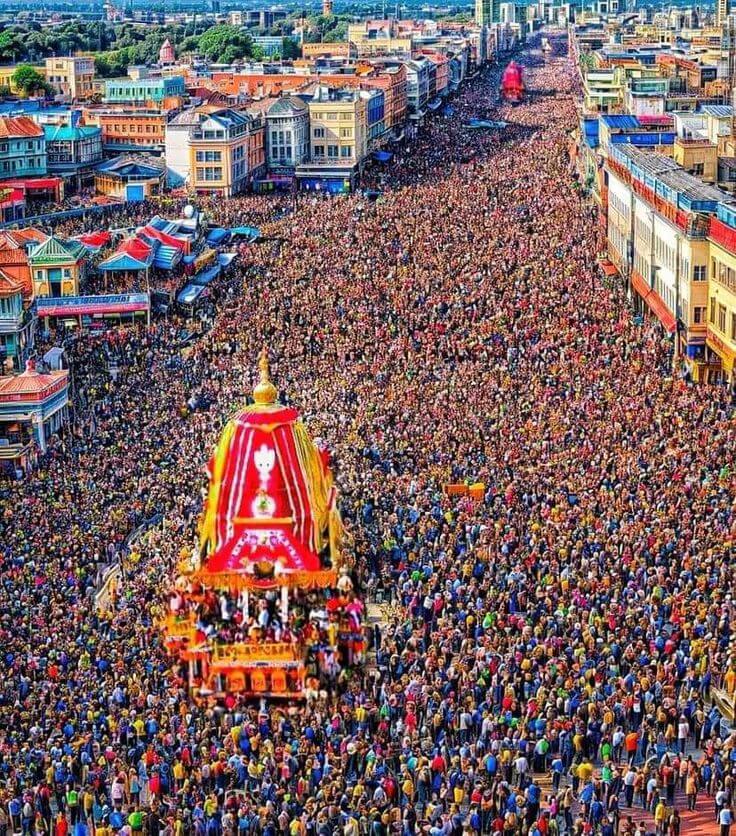
The Jagannath Puri Rath Yatra is an important annual religious celebration held in India, celebrating bhagwan Jagannath, his brother Balabhadra, and sister Subhadra. During this 9-day event, millions of devotees gather to pull three massive, handcrafted wooden chariots, from the 12th-century Jagannath Temple to the Gundicha Temple in Puri, Odisha. As per the Vikram Samvat (the Hindu calendar), the Rath Yatra begins on the Dwitiya Tithi in Ashadha, Shukla Paksha. Per the Gregorian calendar, it falls in the months of June or July.
This year, today (16 July, 2026) is the start of the Rath Yatra in Puri.
The first Rath Yatra of Mahaprabhu Jagannath kicked off on the streets of NYC in 1976, on the 10th anniversary of ISKCON, with assistance from the then unlikeliest of places – from the office of the then-emerging American real-estate tycoon – Donald Trump.
Rath Yatra in NYC in 1976…
This is how the story goes…
About 49 years ago, on the occasion of its 10th anniversary, the International Society for Krishna Consciousness (ISKCON) was planning to organise the first ever Rath Yatra in New York City.
However, challenges were aplenty. The two primary ones being the permission to use Fifth Avenue and the location near Fifth Avenue where the Raths could be built.
On behalf of the Hare Krishna Movement, Tosan Krishna Das who was in charge of getting the permit had submitted a written proposal to the authorities. The Police department had initially said yes but again they said no as there was mayor’s edict since 1962 against allowing new parades on the Fifth Avenue. With no option left, Tosan finally approached the Chief of Police in Manhattan with a special request. Nobody had any clue about how the chief would respond to the application. But after a careful review, the police chief signed the papers with a smile. “I don’t know why I am doing this, the chief said. And then he signed it.” revealed Tosan.
While the grant of parade permit at the Fifth Avenue was secured, which was nothing short of a miracle, a second miracle was needed – of finding a huge empty site close to the starting point of the parade route, where the Raths / Chariots could be built. It was not going to be easy.
The best option was the Pennsylvania Rail Yard nearby. So they knocked at the doors of every person possible who owned a piece of the yard, but in vain. They explained to everyone the requirements they had to build the massive wooden Raths/Chariots. Everyone said No. They were concerned about legal issues, insurance risks etc. Many of the firm owners who were approached reportedly said they were in the process of selling the property at the Pennsylvania rail yard and didn’t want to take a chance. Desperation of devotees reached peak, hopes were nearly shattered.
A few days later, someone told them that the then ‘upcoming’ real-estate businessman Donald Trump had purchased a major piece of the old railway yard.
There were concerns approaching him firstly as a dozen other landlords they had asked for had already said no, so “Why would Trump be any different?” as well as his flashy, high profile lifestyle. Nevertheless, the devotees still tried. They sent an official request. And for reasons known only to Donald Trump, he agreed. Trump signed giving permission to use the open rail yards for construction of Rath Yatra carts.
Like others, Trump also could have easily rejected the proposal. Devotees thought the Police chief was no exception either. Why both of them agreed is still a question unanswered.
Rath Yatra in NYC…
After the peaceful, incident-free successful completion of the first Rath Yatra, the precedent was set. The Rath Yatra has been held continuously since 1976 in New York, even during the Covid shutdowns in 2020, where bhagwan Jagannath was driven down Fifth Avenue in a minivan, along with a virtual online celebration.
However, in the years both before and after 2020, for the past 50 years, there has been a robust celebration in NYC of the Rath Yatra.
This is a video of the Yatra in 2025 in NY, which was celebrated with pomp – rain, et al notwithstanding…
In 2025, the number of cities in the US it grew to were – Fremont (California), Jackson (Mississippi), Centennial (Colorado), New York City (New York), Mauldin (South Carolina), Alpharetta (Georgia), Houston (Texas). The celebrations feature a traditional chariot procession, cultural performances, and rituals that attract thousands each year.
It’s amazing that a celebration so unique to India has become this widespread in the US and it all started with the successful 1976 Yatra, which almost didn’t happen.
The Indo-Canadian relationship comes full circle as recent events invalidate Justin Trudeau’s nonsensical claims… and his vote bank communal politics & his disastrous tryst with Khalistani terrorists.
Backdrop of the Indo-Canadian relationship
India and Canada have had a long relationship. The number of Indians, primarily among them Sikhs who have migrated to Canada is immense. Furthermore, hundreds (if not thousands) of Indian students opt to study in Canadian universities annually. Historically, even the 2 sovereign countries have had decent trade relationships with each other, one example of which is that Canada, being a large grower of pulses, once had India as one of its biggest customers. Not anymore though.
However, in the recent past, things that were in the making for decades have finally come to a head. And while 2018 & 2021 made things worse, 2023 & 2024 have completely blown up the Indo-Canadian diplomatic relationship.
Here’s a short story about how Justin Trudeau’s ugly vote bank politics and pandering to extremists has put him alongside Pakistan as a terror supporter.
20th century & Migration
The Indian Canadian community began to form around the late 19th century – early 20th century, pioneered by men, the great majority of whom were Punjabi Sikhs – primarily from farming backgrounds – with some Punjabi Hindus and Punjabi Muslims, and many of whom were veterans of the British Army. Decades of small waves of migrants continued till 1961, when the total number of Indians in Canada was estimated to be approx 6500.
Then over the next 3 decades, that number jumped enormously to reach over 400k by 1991. Many of these were genuine economic migrants, out to seek a new land of opportunities, but many of them were also asylum seekers who had run away from India to escape the Punjab unrest and government crackdowns against Sikh terrorism & separatism.
That said, there were also many many people who were basically criminals under investigation in india who found seeking asylum to be a good fig leaf under which to hide their criminal antecedents and hence migrate to ‘Kannedda‘. There are several articles, stories, anecdotes about how Canada accepted these ‘asylum seekers’ with no review, no evaluation and did not bother to check with the Indian diplomatic missions whether they were in-fact genuine.
Now whether it was because of the infamous’white man’s burden’ syndrome of the West or some other equally idiotic reason, is immaterial, but the reality is that the Indian diplomatic missions should have been consulted to check someone’s criminal antecedents. And they weren’t.
Anyway, it is among these people who landed up between 1961 and 1984, who brought the seeds of Khalistan / Sikh separatism with them to Canada. While initially their numbers were small & economic clout limited, but by the mid 1980s, that had started to change.
1985 – The worst terrorist attack in Canadian aviation history
On June 23, 1985 Khalistanis carried out the worst terrorist attack to date that Canada has ever witnessed – the Air India ‘Kanishka’ bombing which killed 329+ people, most of them Canadian citizens. The bombing was the handiwork of Babbar Khalsa International (BKI), a Khalistani terrorist outfit and the mastermind was Talwinder Singh Parmar.
The ‘Kanishka bombing’ is the worst act of terror in Canada’s history. Yet only one man – Inderjit Singh Reyat – was convicted and that too decades after the bombing. He too has since been released after he served his sentence and is currently free. The mastermind Talwinder Singh Parmar was never convicted (he was finally killed in 1992 by Punjab Police when he returned to India).
So here Canada had a situation where a handful of radical Sikhs were able to generate Sikh vote banks, on the backs of regular hardworking non-radical sikhs, through their takeover of the gurudwaras & their jathedars. From among them emerged several politicians, one key troublemaker among them being Jagmeet Singh – who led the New Democratic Party (NDP) in Canada. Set up in 1961 as a combination of organised labour & the political left, the NDP was a proper lefty party for a long time, until it was hijacked by the radical sikhs about 2 decades or so ago.
2015 – Trudeau comes to power
So, in 2015, Justin Trudeau & Canada’s Liberal Party came to power after 12 yrs of Conservative rule, with a decent sized majority winning 184 seats in a house of 338 . I remember the global euphoria about the “good-looking young liberal who had defeated the bad-old conservatives” in Canada. I must admit that even I was hoping for good things from him, even though I didn’t really really hear any gravitas from him. Also, upon close scrutiny, one sees that Mr Trudeau had had no major display of professional excellence before he became the Liberal Party’s leader.
This pandering to radical Khalistani separatists has caused a lot of trouble for him over the years, especially during his visit to India in 2018, when he was publicly rebuked by then Punjab Chief Minister Capt. Amarinder Singh who called out the then Canadian Defence Minister Harjit Singh Sajjan (who was part of Trudeau’s delegation) for being a Khalistani (which he was).
Trudeau was also delivered a polite diplomatic version of an insult by PM Modi who did not come to receive him at the airport, met him just once during his visit and engaged in none of the usual fanfare & bonhomie which PM Modi has indulged in with various other heads of state.
Of course, none of them have been handed over since. 😡
On top of all this, the Canadians made things worse, when they invited Jaspal Atwal (a member of the banned International Sikh Youth Federation), who was a convicted criminal for attempted murder – for trying to kill Punjab Cabinet minister Malkiat Singh Sidhu in Vancouver in 1986, to an official event hosted by PM Trudeau during the India trip. The pictures of Sophie Trudeau & Atwal together, which appeared all across media, painted a horrible picture and made things worse. Link: https://www.cbc.ca/news/politics/jaspal-atwal-invite-dinner-sophie-1.4545881
This trip was probably the worst that Indo-Canadian relationship could get. And I’m not even talking about all the jokes & memes that were made of the outfits Trudeau wore during his visit, which were, at best, comical. Like he was auditioning for a Punjabi wedding film or music video.
2019 – Electoral problems for Trudeau and his love for Khalistanis increases to a point where it becomes official state policy
Then, in the 2019 Canadian elections, The Liberal Party dropped to 157 seats, becoming a minority government, supported by the NDP (yes, the same NDP with Jagmeet Singh as its leader)
So then the question that all Indians had then was – with the NDP being a part of the Canadian government, is support to the Khalistan separatist movement official state policy of Canada?
It is important to note that at no stage has Jagmeet Singh even disavowed the Khalistanis, forget opposing them. Infact, signs to the contrary began to appear where support for Khalistani separatism within Canada increased.
2020 and Trudeau’s HORRIBLE opportunism makes things worse
So its 2020 now, and the Wuhan virus hits us all. The pandemic runs riot globally with all governments releasing millions of dollars in aid & payouts to its citizens to enable them to survive the economic downturn caused by the lockdowns. So does Canada…
And therein emerges the despicable political opportunism of Trudeau. At a time when his country was haemorrhaging millions of dollars just to support its citizens, he was actually thinking about how to use this crisis of humanity to his political benefit. 😡
So, in an attempt to augment his political power and try to win back a majority, he calls for early snap elections, halfway through his tenure (which would otherwise end in 2023).
This election ended up costing Canada 610mn$ (Canada’s GDP in 2019 was 1.8tn$).
Can you imagine how horrible it is to spend an additional 610mn$ at a time when there is already so much money flowing out of your country’s coffers, just because you want more power than you already have??? Ugh!!!🤬
The move boomeranged. Whatver gain Trudeau hoped to get from the Covid payouts to Canadians was offset by the disgust felt by voters on how this election was called.
Eventually, all this money, energy & effort was in vain. Almost all the parties won exactly the same number of seats in 2021 as they had in 2019, with a +/- of 2-4 seats.
Honestly, so much money being spent for so little change, is possibly second only to what the US have spent in Afghanistan. 🤷🏻♂️
Not only was it a waste of money, but it emboldened the NDP further, on account of them getting almost the same number of seats as earlier. The Trudeau govt continued in a minority government, supported by the NDP, except Trudeau’s govt was now even more beholden to the NDP, whose leader supports terrorists.
2023 & The Tableau celebrating Indira Gandhi’s assassination in Brampton.
So in 2023 there was a tableau reenacting & celebrating Indira Gandhi’s assassination which was part of a parade in Brampton.
Question: What kind of a supposedly democratic country, in the 21st century, allows this under freedom of expression? Answer: One whose government relies on Khalistani terrorist elements for their vote bank and is willing to aid & abet celebration of terrorists & terrorism.
Celebrating the killing of former Prime Minister of India by re-enacting it, is not ‘freedom of expression’ as claimed by Canada. It is celebrating an act of terrorism. Can you imagine Canada celebrating the re-enactment of the downing of the twin towers by Bin Laden?
2023 June/July and the despicable call to violence and the calling for the killing of Indian diplomats
Hardeep Singh Nijjar, a designated terrorist (not a plumber!), the chief of a Khalistani outfit Khalistan Tiger Force (KTF) was shot dead in Surrey, British Columbia on June 18, 2023. Nijjar was responsible for promoting the separatist agenda of the Gurpatwant Singh Pannun – run ‘Sikhs for Justice’ (SFJ) and calling for all kinds of ridiculous ‘referendums’ in Canada on Khalistan.
After Nijjar’s assassination, the following posters were released. and put up all over Toronto, calling for a rally on July 8th and also calling for the murder of Indian Diplomats.
This was clearly INSANE. That Trudeau’s government would sit back on this, do nothing and allow this call to violence by a bunch of terrorists is despicable.
India served a demarche on Canada. The Trudeau govt was asked by the Indian government to take strong measures to prevent protesters from congregating close to missions and consulates or desecrating the Indian national flag or throwing projectiles into the Indian diplomatic premises in Canada.
When asked about these posters, Trudeau said “We have an extremely diverse country and freedom of expression is something that we have. But, we will also make sure that we are pushing back against violence and extremism in all its forms.”
Here are a couple more images / videos of the nonsense going on in Canada in September 2023.
This is terrorism. Plain & simple. And Trudeau saying that this is ‘free speech’ is nothing short of active encouragement of terrorism.
2023 September and Trudeau’s nonsensical allegations about India
On 18 September 2023, Justin Trudeau, addressing the House of Commons said “Over the past number of weeks, Canadian security agencies have been actively pursuing credible allegations of a potential link between agents of the government of India and the killing of a Canadian citizen, Hardeep Singh Nijjar. Any involvement of a foreign government in the killing of a Canadian citizen on Canadian soil is an unacceptable violation of our sovereignty”.
He added that he is asking the Indian government to cooperate in the ongoing investigation. Trudeau stated that he had presented the accusations directly to Prime Minister Modi during the G20 summit in New Delhi.
The Indian Ministry of External Affairs rejected Trudeau’s allegations saying “claims of India’s involvement in any act of violence in Canada are absurd and motivated“. It added that similar accusations made earlier by Trudeau to Prime Minister Modi had been “completely rejected” by him. The Indian statement further said that “Such unsubstantiated allegations seek to shift the focus from Khalistani terrorists and extremists, who have been provided shelter in Canada and continue to threaten India’s sovereignty and territorial integrity“. India urged Canada “to take prompt and effective legal action against all anti-India elements operating from their soil“. It said that “Canada’s inaction has been “a long-standing and continuing concern“.
September-October 2023 – The diplomatic row escalates…
On 18 September 2023, Canadian foreign affairs minister Melanie Joly announced that Canada had expelled Pavan Rai, a “senior Indian diplomat” for “foreign interference”. She further said that India’s involvement if proven true would be “a great violation of our sovereignty and of the most basic rule of how countries deal with each other“.
On 19 September 2023, India expelled a top diplomat of Canada with five days’ notice to leave the country amid “growing concern at the interference of Canadian diplomats in India’s internal matters and their involvement in anti-India activities“.
On 20 September 2023, India issued a travel advisory to its citizens on travelling to Canada, warning them about “growing anti-India activities and politically-condoned hate crimes and criminal violence” in Canada.
On 21 September 2023, Indian external affairs ministry spokesperson Arindam Bagchi announced that India has “temporarily suspended the issuance of visas or providing visa services” for all Canadian nationals in all categories, including e-visas and for Canadian citizens applying from third countries, due to “security threats” against its diplomats.
On 24th September 2023, the Indian government instructed its investigative agencies to identify all Khalistanis in Canada, the United States, the United Kingdom, and Australia and cancel their Overseas Citizenship of India card to prevent them from entering India, in addition to confiscating their assets in India.
In early October 2023, India asked Canada to withdraw 41 of its 62 diplomats from the country and threatened to revoke the diplomatic immunity of diplomats who would remain after a certain date. India’s Ministry of External Affairs issued a statement stating that “Their continued interference in our internal affairs warrant a parity in mutual diplomatic presence in New Delhi and Ottawa“. On 18 October 2023, 41 Canadian diplomats along with 42 of their family members left India. The Canadian foreign ministry said that Canada will temporarily close three consulates in India and concentrate services at its high commission in Delhi, with only 21 diplomats remaining in India. Canada’s immigration minister, Marc Miller said that the situation would cause delays in the immigration applications and processing of visas for people in India.
As of today, Canada has not provided any evidence linking the Indian government to Nijjar’s death.
On 22 September 2023, two days after the Canadian government accused Indian agencies of killing Hardeep Singh Nijjar, the Premier of British Columbia David Eby informed the media that the “intelligence briefing” received by him from the director of the Canadian Security Intelligence Service (CSIS) was based on open-source, internet material and there was no explicit evidence that he had seen. Basically, the CSIS & the RCMP (Canadian Police) had nothig.
October 2024 and the “Persons of Interest” communication and the Indian response.
On 13th October 2024, India received a diplomatic communication from Canada suggesting that the Indian High Commissioner and other diplomats are ‘persons of interest’ in a matter related to an investigation in that country and should make themselves available for an investigation.
After this nonsense by Trudeau, this is what our Ambassador to Canada was subjected to. His effigy being shot by a gun & burnt. By every application of the Brandenburg Principle (which governs what constitutes a valid threat) this is a criminal offence. But the Canadian Police basically ignored this completely.
The Indian government’s response to all of the above was appropriately harsh… as under…
I have never seen such language being used by India diplomatically for another country. Not even for Pakistan. Trudeau had gotten the world’s largest democracy to treat him & Canada with language worse than what India uses for Pakistan – a corrupt tinpot military-terrorist-dictatorship.
After this, the same day India downgraded the diplomatic relationship with Canada & withdrew its High Commissioner.
Then, Canada expelled 6 Indian diplomats
And India did the same…
This is an interview by former Indian High Commissioner to Canada – Sanjay Varma – who was the target of all kinds of abuse, death threats and attacks.
March 2025 – Ding Dong, the psycho’s gone!
After a disastrous 12 months economically, diplomatically & politically for Trudeau, he finally resigned on March 14, 2025. And I kid you not – there were schadenfreude-filled firecrackers going off all across India.
BTW, it has not come to light through media reports (in July 20026) that Trudeau was specifically told by CSIS & RCMP NOT to name the Indian government. The very next day, he named the Indian government after he was told not to. Trudeau, in his arrogance or stupidity (whatever you want to call it), ended up massively denting the Canada-India relationship.
Carney – A New Hope
2025 elections and Mark Carney wins. Thanks in significant part due to Donald Trump and his weird ‘Canada is US’s 51st state’ rhetoric, the ahead-in-the-polls Pierre Pollievre lost and the Liberal party came back to power, with Mark Carney as PM.
One of the many things that Carney did when he took office was to undo some of Trudeau’s insanity re India. To the best of his ability, he has tried to repair the Indo-Canadian relationship.
Both countries have since then reversed the downgrading of their relationship and positioned High Commissioners in both countries.
The other key thing Carney has done is that he has never stood alongside Khalistanis, not ever gone to any of their rallies nor partnered with (he didn’t need to thankfully) the NDP / Jagmeet Singh.
Things started to get better with Dinesh Patnaik being deputed as High Commissioner to Canada.
Here are a couple of good interviews done by India’s new High Commissioner Dinesh Patnaik with Canadian media.
2026 July & Operation Hard Ball
Operation Hard Ball is a sweeping, multinational law enforcement crackdown led by the US Department of Justice and the FBI targeting three transnational criminal syndicates with operations in Canada, US and to a smaller extent in Europe. The sweep resulted in 24 arrests, 37 indictments, and major seizures of narcotics and firearms across the US, Canada, and Europe.
Now watch this interview by the Deputy of the RCMP from yesterday, where she talks about NO INDIAN INVOLVEMENT in the murder of Nijjar.
The full interview can be seen here…
This not only invalidates Trudeau’s ridiculous claims, but basically calls him a liar for this lunatic claims against India.
While over the past few months, Mark Carney has already started to mend Canada’s relationships with India, it is definitely going to take a long long time before any serious professional in India’s political establishment takes anyone from Canada seriously or has even an iota of trust on anything anyone from Canada says.
In Conclusion
I really don’t know what Canadians think about their former PM’s behaviour towards India, his alliance with the NDP and his support of terrorism, and I honestly don’t care, but unless a clear stand continues to be taken by the Canadian government against Khalistan terrorists, the slowly-getting-better Indo-Canadian relationship will regress.
It is tragic what has happened under Trudeau. By joining hands with terrorists he got himself into the PM’s office twice, but at what cost? Canada’s perception has taken a horrible beating in India. Canadians must think about what their erstwhile government’s aligning with terrorists has done to their country. These Khalistani jokers will never succeed in India but they will destroy Canada and, more-importantly, will destroy the Indo-Canadian relationship.
Canada must do some deep introspection on what they can do about it…
P.S.: Canada has been a safe haven for global terrorists for decades. Even the Bangladeshi Army officer who assassinated the founder of Bangladesh – Sheikh Mujibur Rahman has been hiding in Canada for 25+ years.
P.P.S. Here are 3 videos which deconstruct the stark hypocrisy of ‘good-boy’ Justin Trudeau.
Tesla + SpaceX today have a combined market cap of 3-trillion$-plus and Elon Musk is the world’s richest man (with a verified net worth estimated to be over 1trillion$). What almost nobody in the mainstream media has spoken about (possibly out of embarrassment) is that for nearly 7 years now, Tesla has made reporters and mainstream media irrelevant for its external communication.
Since late 2019, the press@tesla.com email id had stopped responding to reporters. In October 2020, Tesla officially dissolved its PR department, effectively formalising their informal policy of ignoring reporters & mainstream media. Keely Sulprizio, the last person known to officially be in charge of PR/communications at Tesla, left the automaker in December 2020. Tesla still has a few PR people on the rolls, but their role is primarily reaching out to & arranging test-drives / promotions for YouTubers & social media influencers.
Elon Musk personally does almost no mainstream media interviews but has chosen to go onto radio shows and podcasts of individuals he likes like the All In Podcast, Joe Rogan & Lex Friedman and occasionally on comedy shows like Jon Stewart & Bill Maher.
The very few mainstream media interviews which he has done have been extremely combative, where he has wiped the floor with agenda-driven-journalists. Case in point – check out this compilation of excerpts from a 2023 BBC interview.
The entire interview is here –
Another example is this conversation with CNBC…
Please note that in October 2020, Tesla + its associate companies market-cap was 400bn$. Today, it is around 8 times that. It is clear that Musk’s strategy of ignoring reporters and mainstream media has made zero difference to the group’s stock prices or market cap. No amount of badmouthing by mainstream media seems to have affected the plurality of people buying Teslas, using Starlink or the companies using Musk to launch satellites.
This is not an exception. We are living through a historic shift in the balance of power between the media and its principals. And the principals are winning.
The internet in general, and social media platforms in particular, have heavily degraded the mainstream media’s source of power – ACCESS – i.e. – they being the only ones to offer its principals access to an audience. That source of power is now gone.
If a Elon Musk can say whatever he wants to 240 million X followers & the same is amplified both by news aggregators and the 240mn people who follow him, exponentially expanding its dissemination, then it is little surprise that he does not feel compelled to waste his time engaging with reporters. Especially those with agendas.
Mukesh Ambani (India’s richest man worth 110bn$) has done a maximum of 2 media interaction every year for the past decade or so (these include chats at media business summits). The RIL Annual General Meeting continues to be highly anticipated and is one of India’s most-watched-live financial events, second perhaps only to India’s annual budget. Reliance Group’s market cap is 220bn$ and has grown 310% in the past 5 years. The group is India’s market leader in Energy, Communication and Media & Entertainment. Which is ironic, given how little Mukeshbhai interacts with mainstream media.
It is crystal clear now that popular / well-followed-on-social-media people no longer need to suffer ‘mainstream media’, and they especially don’t need to suffer those with agendas. This presents a problem more for the media than them. If the mainstream media is left to simply copy-paste information from the company’s social media handles, why would anyone value them more than they value a news aggregator? Media still needs access to popular and powerful people, to offer them up to audiences, so that the audiences remain their viewers/readers. Very very few among the media are so good journalistically, that people will read / watch their content only for its editorial / opinion value, even if they do not provide access / ‘inside info’ to popular & powerful people.
PM Modi is (per Morning Consult) the most popular world leader currently with an ‘approval rating’ in the 68-70% range. He has won 3 elections in a row and the BJP governs over 78% of Indian states which house over 72% of India’s population.
PM Modi is also the most followed person on social media in India (he has a combined following of nearly 300 million across Twitter, Facebook, Instagram & YouTube – 107mn + 57mn + 102 mn + 30mn), and with his Mann ki Baat radio address, he has the ability to reach out, directly, potentially to 1.4bn Indians all at the same time (radio has 90%+ penetration across India).
He has avoided mainstream media so much that he averages 5 interviews every 5 years, mostly around general elections. He has had zero press-conferences over the past 12 years, and his media interactions are restricted to a few select interviews and some questions taken alongwith world leaders at joint appearances (those too are in single digits). His public presence however is significant. From election rallies & roadshows to public conversations like Pariksha pe Charcha, interactions with YouTubers / Influencers / Gamers, the Mann-Ki Baat addresses and speeches at Summits / Conclaves organised by media groups are plentiful.
This combination of high public engagement with very low mainstream media exposure has been a well worked out strategy by him to get his message out and be elected India’s Prime Minister 3 times.
In the case of India’s newest Chief Minister – Joseph Vijay – he has gone even more radical with his media avoidance stance. His party, which is barely 2-yrs-old has won India’s most industrialised state and Vijay is today Chief Minister of Tamil Nadu.
Vijay has intentionally completely avoided mainstream media, preferring instead to connect with the public through direct speeches at mass rallies and party events. He has thousands of fan clubs across TN and through them & their WhatsApp / Telegram groups, he is able to reach out directly into people’s phones. While he did make promotional appearances alongside the crew for his 2024 film The Greatest of All Time (GOAT), he did not conduct one-on-one sit-down interviews or press meets even at that time. He has had zero interactions with mainstream media (Tamil media, national media – nothing, zilch!). He has not even made an official casual comment to any TV channel, reporter or journalist in the past 2 years. Even when there were controversies around his personal life (divorce, Trisha, etc), he did not engage. This has got to be the most active shunning of mainstream media ever done by a politician. Especially one so new & fresh. Choosing to forego the easily-available publicity that engagement with mainstream media gives a politician is unheard of. And despite all this, he has still won and is currently Chief Minister.
The case of PM Modi, CM Vijay & Mukesh Ambani is unlike Tesla in one aspect. BJP, TVK & Reliance all have super-active organisational PR departments and social media cells (the infamous BJP IT Cell included). So while mainstream media has little or no access to the top man, they do get responses by the organisational communication machinery. In the case of Tesla, Musk has broken down that link as well. No institutional contact with mainstream media. His X feed and that of the companies is all they get.
That it is happening is not at all surprising for me. And is a glaring example of what can happen to a compromised & static entity like the mainstream media in a dynamic world. If media interactions are a binary between “chamcha or morcha” (the ‘chamchas’ are always praising the principal and the ‘morchas’ are always against the principals, come what may), then those with direct access to the people do not want any filter between their words and their recipients. Especially if that filter is coloured with an agenda. I’m not saying that it is the ONLY reason for such media avoidance, but IMO, it is definitely one of the primary reasons.
Incidentally, PM Modi, before he became PM, was extremely engaging with the media. He used to be a regular on news debates, conclaves & summits and was always available for media interviews. It all changed over the 2002-2012 decade. His mainstream media interactions & interviews before 2012 were plenty, fiery and extensive. After 2014 – ZERO. He has also completely stopped carrying mainstream media journalists along for free-rides on the PM’s aeroplane during international trips.
Now the media may raise all the questions they want about this lack of access to Musk, Modi, Ambani & Vijay and go full-tilt rudaali on how elected leaders / important business leaders are not doing press conferences and that the media, as ‘the 4th pillar of democracy’, deserves open access to everyone, etc, etc, but before they do that, they should ask why this has avoidance has happened and why a vast majority of the people (who the media are supposed to serve) do not care that it has.
P.S.: Donald Trump is exactly the opposite of these 4 people. He has multiple mainstream media engagements daily, berates the media all the time but continues to engage with them all the same. I am befuddled at how he is able to do this. Really befuddled!
Antahkarana Chatushtaya is a concept of understanding the ‘you’ in each human. It is the Complete Map of the Human Mind 😊🧠😊
Sanatana thought / Vedanta does not treat the mind as a single entity. It describes an inner instrument called the Antahkarana – made up of four distinct functions.
Together these four explain thinking, decision making, memory, identity, and human experience itself.
They are:
1. Manas – the mind The faculty of thinking, doubting, comparing, and processing sensory information
It constantly asks: “Should I do this or that?” “Is this right or wrong?” “Do I like this or not?”
Manas generates possibilities But it does not make final decisions
2. Buddhi – the intellect The faculty of discrimination, judgement, reasoning, and determination
It evaluates options and arrives at conclusions
Manas proposes. Buddhi decides.
This is why Buddhi is considered the seat of wisdom and discernment.
3. Chitta – the storehouse of impressions The repository of memories, samskaras, experiences, and latent tendencies
Every experience leaves a trace in Chitta
What you remember. What you fear. What you are unconsciously drawn toward.
All emerge from this deeper layer
4. Ahamkara – the ego / identity The faculty that creates the sense of “I” and “mine”
It appropriates experiences and says: “I am thinking” “I am suffering” “This belongs to me”
Without Ahamkara, experience occurs, but personal ownership does not arise
These four are constantly working together: – The senses bring information to Manas – Manas presents it to Buddhi – Buddhi consults Chitta – Ahamkara claims the entire process as “my experience”
However the most important concept of ‘You’ is that: – You are not Manas – You are not Buddhi – You are not Chitta – You are not Ahamkara You are the awareness that subsumes all four.
You are not one thing. Your self is both made up of and includes this ‘system’.
Think about it the next time someone asks you – “WHO ARE YOU?” 😇
Last year at the Kumbh Mela, we saw plenty of visuals of the Naga Sadhus. Almost always they are described by the media as “ascetics who live in the himalayas and come to Prayagraj for the Kumbh”. This description, fuelled by deracination of the worst kind, includes zero detailing of who the Naga Sadhus are and what their role in Bharat’s history has been.
Here I write about just one of what I am sure are thousands of examples in history of Naga Sadhus’ role in a key historical event of our civilisation and why they are also referred to as ‘Shiva’s Sacred Warriors’.
Here goes…
When 4,000 Naga sadhus defended Gokul and forced the retreat of a 40,000-strong army of Ahmad Shah Abdali
1757 is when Ahmed Shah Abdali invaded India for the 4th time. After looting Delhi in February 1757, he instructed his two Afghan commanders Najib Khan and Jahan Khan to take 20,000 Afghan soldiers each with them and carry out similar raids & loot in Ballabgarh, Mathura, Agra, Vrindavan.
As mentioned in his official decree, “The city Of Mathura, Vrindavan is a holy place of the Hindus, let it be put entirely to the edge of the sword right upto Agra leave not a single place and raze every building to the ground, whatever booties you would get in the wars will be yours, behead the Hindu Kafirs and gift their head in Afghan camp to me and take Rs 5 as a reward for that.“ -Ahmad Shah Abdali
As the Afghan army reached Mathura, they started destroying temples, killing men, raping women & taking them as sex slaves. Also enslaving children. Many women jumped in the Yamuna committing suicide so as to escape from the murderous Afghan maniacs. The Afghan army captured bounties worth Rs 12 crore, enslaved 6,000 Hindu women for selling them in Kabul.
After attacking Mathura, the Afghan marched towards Vrindavan and then Mahaban, and these cities too met the same fate as that of Mathura.
After destroying Vrindavan, while the Afghan army’s next target was to attack Agra but one of the commanders, Sardar Khan decided to plunder and loot Gokul as well, which is just about 10 kms away from Mahaban and he along with 10,000 Afghan soldiers marched towards Gokul.
Nearing the city, they had a completely unexpected sight. Approximately 4,000 Naga Sadhus were waiting for them outside the city limits, ash smeared and ready for war.
Word is that, when the Naga sadhus had heard about the plight caused by the Afghans of Hindus in Mathura, they had made their way into Gokul from all around – from Haridwar, Ujjain, etc and had set up in defence of Gokul. At first Afghans anticipated that the Nagas wouldn’t be able to counter them for long but soon they were proved wrong as the Afghan soldiers started to get overwhelmed by the Naga sadhus’ strength, speed & military skill. The sadhus were well trained in the use of swords, matchlocks & cannons.
Also apparently the ash-smeared faces were terrifying the Afghan soldiers so much that they were unable to give any resistance to the Nagas at all. With heavy casualties, the Afghan army started suffering, due to which their strength now started decreasing drastically on the battlefield. Word of this reached Abdali enraging him further and he threw 30,000 more troops into this battle. But all that did was extend the battle and not change its result.
By the end of the battle, more than 5,000 afghan soldiers had died and about 4 times as many were injured, whereas approximately 2,000 Nagas had attained martyrdom in this battle.
The Afghan commander Sardar khan was aware that Abdali would punish him for his decision of retreating from the war with humiliation since they had been victorious everywhere from Kabul to Mathura and a defeat at hands of the ‘ascetic’ Nagas was a big blow to them. So he bribed Jugal Kishor who had been appointed by Abdali from Bengal for inspecting the war and documenting the loot / treasure caught in war, to frame a false report that Afghans retreated due to the spread of an epidemic in the Afghan army and that Gokul was actually just a simple town full of sadhus and there was nothing to loot there, so that he could escape from the penalty of losing the battle of Gokul and returning defeated & humiliated.
The point of this story is…
The Naga Sadhus aren’t merely ‘ascetics who live in the himalayas’.
Also, Bharat’s warriors have come from all walks of life. Spirituality and battle are both ingrained in our history. We are NOT a ‘turn the other cheek’ civilisation. We are not the one who throw the first punch, but by Shiva we will be the one to throw the last punch.
And lastly, don’t fcuk around with the Naga Sadhus!!! 💪🏻🤜🏻💥🤛🏻💪🏻
——————————-
P.S. Check this out…
Paragraph from the book ‘Ahmad Shah Durrani, Father Of Modern Afghanistan’, Asia Publishing House,1959.
(this article is inspired [a politically correct word for stolen] from DK Singh’s piece in the Print)
Think back to the period from 1995 – 2004. This was the period when Naveen Patnaik, Mamata Bannerjee, Nitish Kumar (and even the Shiv Sena to an extent) used Vajpayee-Advani’s BJP to grow. Modi-Shah’s BJP are now claiming the return on those erstwhile investments.
Biju Janata Dal – In 1997, Naveen Patnaik was best known as a Delhi-based socialite – famous among the media & the Lutyens folk for his love for his Dunhill cigarettes and Famous Grouse whisky. When his father, Biju Patnaik, passed away in 1997, Naveen struck an alliance with the then BJP leaders in Vajpayee and Pramod Mahajan to deal with his late father’s wily colleagues in the Janata Dal (BJP had little to no presence in Odisha). Together they prevented any appropriation of Biju Patnaik’s legacy by anyone else and formed the BJD with Naveen Patnaik gaining full control of his father’s legacy and of Odisha. Both sides benefited as BJP got its first MP (7 of them actually) from Odisha in the 1998 Lok Sabha elections. Then the BJD-BJP duo brought down the Congress government in 1999, with the BJP as a junior partner. By 2009, Patnaik had become a seasoned politician and seeing BJP’s widening footprint as a threat, he broke ties with the party ahead of the 2009 elections, leaving it weak for the next decade.
Today, the BJP in full control of Odisha – both in the Lok Sabha and state assembly. Some of the BJD’s tallest leaders (Jay Panda, etc) are in the BJP. The BJD is a pale shadow of itself with a ageing Naveen Patnaik & almost no 2nd rung leadership.
Trinamool Congress – Mamata Banerjee split from the Indian National Congress in 1997 because she believed the party was incapable of aggressively opposing the Left Front in West Bengal. Following a period of growing isolation and clashes with the state leadership, she was officially expelled from the Congress in December 1997. Mamata then joined hands with the BJP in the 1998 Lok Sabha elections – as a win-win for both. Banerjee’s newly floated AITC ended up with seven Lok Sabha seats. Further, the Vajpayee-Advani BJP was desperately seeking to end its political untouchability, which it achieved through this alliance and got a bonus by winning its first-ever MP from Bengal (Tapan Sikdar from Dum Dum). The BJP’s tally went up to two in the 1999 Lok Sabha elections and they got their first MLA in Bengal (in a bypoll – Badal Bhattacharya from Ashoknagar). Cut to 2001, where the AITC having become very powerful and believing that the BJP would be unable to help her win Bengal vs the Left, Bannerjee left the NDA in 2001 over the Tehelka expose and went with the Congress in the Assembly elections that year. They did not win. So Mamata returned to the NDA ahead of the 2004 Lok Sabha elections, only to leave it again after the 2006 Assembly elections.
For Mamata, the BJP’s political utility in her fight against the Left was over. However, what she did end up doing was rekindling the political legitimacy that Shyama Prasad Mookerjee’s BJP once had as a political force in West Bengal.
Today, BJP has complete dominance in Bengal in the assembly and the Lok Sabha, through elections and defections. AITC has less than 10 MPs and less than 30 MLAs. And we see Mamata trying to cozy back with the Congress in order to borrow some political clout. The Bengal Chief Minister is a former AITC leader.
Janata Dal United – In 1994, when Nitish Kumar fell out with Lalu Yadav and formed the Samata Party in 1994 with George Fernandes, he was no mass leader. They entered into an alliance with the BJP in the 1996 general elections, as Vajpayee-Advani’s party was a bigger force. This association gave time and political exygen to enable Nitish to grow into a political force in Bihar and eventually become the bigger brother in the alliance. He then continued to use the BJP at his whim and political convenience, even to a point where he cancelled a dinner in Patna to snub Narendra Modi in 2010. There have been four flip-flops where Nitish came & went away from the BJP between 2010 and 2024.
Today, the BJP has full control over Bihar. It has its own CM, a bunch of MPs and MLAs and all of JDU’s leaders are pro-BJP where there isn’t even a whiff of them looking for options. Hence, despite the numbers being almost equal, the JDU is perceived to be beholden to the BJP for political relevance, both at the centre and the state.
What’s common between these three leaders is that they used the Vajpayee-Advani’s BJP to grow into serious politicians. The BJP used them to shed its political untouchability and expand its footprint in different states. And, given that the relationship was transactional given the flip flops, the BJP using these parties to grow and eventually surpass them is basically the mirror image of what they did with the BJP in the past – to be used and dumped at will.
It is also interesting to note that at some point in the past 30 years, BJP has had its most aggressive political campaigns against these leaders & vice-versa.
Shiv Sena – Bal Thackeray had fielded two Shiv Sena leaders on the BJP’s symbol in the 1984 elections as a precursor (testing waters / evaluating BJP’s political legitimacy in Maharastra) to their formal alliance in subsequent elections. All the way from 1995 through 2019, they stuck together with the BJP growing in political heft in Maharashtra where, at one point, the Sena became a junior partner to the BJP. When, in 2019, in a strange display of political myopia, Uddhav Thackeray parted ways with the BJP and partnered with Congress & NCP (undivided) – two parties that the erstwhile duo (BJP-Sena) used to vitriolically battle for nearly 3 decades, he started walking down the path which ended with the Thackerays losing the Shiv Sena and the BJP running the show.
Today, the BJP dominates the Maharashtra assembly and though the Shiv Sena (minus the Thackerays) has 50% more MPs in Maharashtra than the BJP, but they are seen as basically the BJP’s junior partner, not the erstwhile Shiv Sena, which was the senior partner to the BJP.
There was a time when regional parties found in the BJP a convenient ally in their fight against then-dominant Congress (or the Left in Bengal). What has happened to Banerjee, Patnaik, Kumar, Thackeray and many others today is that they didn’t factor in that the debt comes due. Modi-Shah’s BJP is different from Vajpayee-Advani and they are here to collect.
P.S. the Assam story is even more intriguing. In 2020, the BJP’s coalition partner in the state, the Bodoland People’s Front (BPF), emerged as the single largest party in the Bodoland Territorial Council (BTC) election. The BJP however, partnered with the United People’s Party Liberal (UPPL), the second largest, to form the government in the Bodoland Territorial Region (BTR). A miffed BPF then went with the Congress-led Opposition alliance in the 2021 Assembly elections, but ended up on the Opposition benches.
In September 2025, the BPF swept the BTC election, defeating the BJP-UPPL alliance. So, the Assam chief minister Himanta Biswa Sarma brought the BPF back into the Assam government. In the 2026 Assembly elections, the BJP left the UPPL high and dry, giving 11 seats to the BPF and itself contesting four other seats in the BTR. The UPPL had to contest on its own and ended up with zero seats. Essentially, between the BPF and the UPPL, whichever regional party wins, the BJP brings them into its fold at the state level.
Gabriel García Márquez was 13 years old when he saw Mercedes Barcha at a school dance in Colombia. She was beautiful, confident, untouchable. He turned to his friends and made a declaration that sounded like adolescent fantasy: “I’m going to marry that girl.”
She barely knew he existed.
He was a scholarship student from a struggling family. She was the pharmacist’s daughter, comfortable, refined, completely out of his league. So he did what dreamers do when reality won’t cooperate: he left to make something of himself.
Eighteen years passed. He moved from city to city, chasing journalism jobs and literary dreams, always broke, always writing, always thinking about the girl he’d promised to marry.
In 1958, finally established as a serious journalist, he returned for her. This time, she said yes. They married, had two sons, and built a life that was rich in everything except money.
Márquez wrote. Published novels. Earned critical praise but little income. Mercedes stretched every peso, managed the household, believed in her husband’s talent when the bank account suggested she shouldn’t.
Then in 1965, while driving to Acapulco, something extraordinary happened. The entire plot of a novel appeared in his mind, complete, fully formed, as if downloaded from somewhere beyond himself. Seven generations of the Buendía family. A town called Macondo. Magic woven into reality. Love and war and solitude across a century.
He turned the car around and drove straight home.
“I need to write this book,” he told Mercedes. “It’s going to take a long time, and we’re going to run out of money.” She looked at him steadily. “Write it.”
For eighteen months, García Márquez disappeared into his study. Every day, all day, possessed by the story of Macondo. He quit journalism. Stopped earning entirely. Their savings evaporated.
Mercedes became the architect of their survival. She dealt with landlords, creditors, utility companies. She sold their car, their only valuable possession.
She shielded him from every financial emergency so he could stay inside the story. She told their sons to be quiet when Papa was working. She refused to let reality interrupt the dream.
Friends thought they were insane. Family begged him to stop writing and get a real job. Why was he wasting time on a novel when his children needed shoes?
But Mercedes never wavered. Not once.
In 1966, the manuscript was finished. Nearly 500 pages. One Hundred Years of Solitude, the story he’d carried inside him, now real, typed, ready to send to the publisher in Buenos Aires.
They stood in their apartment holding the finished work, exhausted and triumphant
Then they tried to mail it.
International postage from Mexico City to Argentina was expensive. The manuscript was heavy. They counted every peso they had left in the entire apartment.
Not enough!
Mercedes didn’t hesitate. She walked through their home gathering everything they hadn’t already sold. Jewelry. A radio. Kitchen appliances. And her hair dryer, a small luxury she’d treasured, one of the few nice things she still owned. She sold it all.
They took the money to the post office, packaged the manuscript, those 500 pages that represented eighteen months of work and years of poverty, paid for postage, and handed their entire future to a postal clerk.
Walking out of the post office, completely broke, not a single peso left, Mercedes turned to her husband and said: “Now all that’s left is for the novel to turn out bad.”
It was a joke. But it was also the truth. They’d gambled everything on words in a box.
One Hundred Years of Solitude was published in June 1967.
Within weeks, it exploded. First edition sold out immediately.
Then the second. Then the third. Translations into dozens of languages. Critics calling it a masterpiece. Readers unable to stop talking about the Buendías, about Macondo, about this magical, heartbreaking, astonishing book.
It has now sold over 50 million copies in 46 languages. It’s taught in universities worldwide. It’s considered one of the greatest novels ever written in any language.
The poverty ended. They bought a beautiful home in Mexico City. Traveled the world. Never worried about money again. But Gabriel never forgot what it cost, or who paid the price.
In 1982, largely because of this book, Gabriel García Márquez won the Nobel Prize in Literature.
For the rest of his life, in every interview, he credited Mercedes as “the real author” of One Hundred Years of Solitude. He said she created the conditions that allowed him to write it. He called her the strongest person he’d ever known.
They stayed married for 56 years, until his death in 2014. Mercedes died in 2020 at 87. 15 August 2020.
The hair dryer money bought postage for a manuscript. But Mercedes’s faith bought something far more valuable: the space for genius to exist. The permission for art to breathe. The belief that some things are worth risking everything.
The world got One Hundred Years of Solitude because one woman was willing to sell her hair dryer and bet on her husband’s impossible dream.