So all of India (and the world actually) would have seen this man on the field when India won the past two T20 World Cups as well as the Asia Cup. This man, who seems like an ‘civilian’ (not from the team) with a permanent teeka on his forehead, is an extraordinary talent from Karnataka.
A boy who left home with just 21 rupees has been one of the key figures behind Team India for more than a decade now!
A boy who dreamt of becoming a cricketer. Then his hand got fractured, and his cricket dreams shattered. However, determined to find what he lost, today he stands as one of the key contributors to India’s cricketing triumphs.
During the 2017 Champions Trophy, Virat Kohli said, “This man has a huge role in my success today, but his hard work almost always goes unnoticed by the world.” Former coach Ravi Shastri called him the “heartbeat of the team,”
He is Team India’s throwdown specialist, Raghavendra Dwivedi (aka Raghu) – hailing from Kumta in the Uttara Kannada district.
Those who think everything is over in life because of one adversity should hear Raghavendra’s inspiring story.
Raghavendra had an extreme passion for cricket, while his father was allergic to it. Seeing his cricket obsession, one day his father asked him, “What is more important to you, studies and life or cricket?” Without hesitation, with just a bag in hand and 21 rupees in his pocket, Raghavendra left home. From Kumta, he went straight to Hubli. For a week, he slept at the Hubli bus stand. When the police chased him away, he found refuge in a nearby temple for ten days. Eventually, he had to leave there too and had no choice but to settle in a nearby crematorium.
He made an abandoned building in the crematorium his home, using a mat from a cricket ground as his blanket. For four and a half years, Raghavendra slept in the crematorium and worked odd jobs trying to make it into cricket somehow. During this time, his right hand got fractured, ending his dream of playing cricket. Determined not to return home, he turned his focus to cricket coaching. Initially, in Hubli, he assisted cricketers by throwing balls and helping with their practice. A friend then guided him to Bangalore. In Bangalore, at one of the Karnataka Cricket grounds, he found shelter. His job was to throw balls to Karnataka cricketers who came for practice and to help them with loading and operating the bowling machine.
One day, former Karnataka wicketkeeper and current Under-19 selection committee chief Tilak Naidu noticed his work. Impressed by Raghavendra’s dedication, Tilak Naidu introduced him to another former Karnataka cricketer, Javagal Srinath.
This was a turning point in Raghavendra’s life. Recognizing the boy’s sincerity, Srinath invited him to join the Karnataka Ranji team. During the cricket season, he worked with the Karnataka team, and when there was no work, he served at the National Cricket Academy near the Chinnaswamy Stadium. While at NCA, he completed the BCCI level-1 coaching course. He became a favorite among Indian team cricketers who came for practice. Sachin Tendulkar quickly recognised Raghavendra’s talent, leading to his appointment as a training assistant with the Indian team in 2011.
For the past 15 years, Raghavendra has played a significant role in the team’s success. Joining the Indian team as a throwdown specialist in 2011, Raghu might have thrown at millions of balls during practice sessions over the last decade. He uses a sidearm sling tool to hurl balls at blistering speeds of 150–155 km/h. Facing his deliveries, which come at speeds of 150 kph, requires extraordinary courage. He replicates lethal fast bowling, steep bounce to help top-order batsmen prepare for elite international attacks.
Both Rohit & Virat repeatedly have said that facing Raghu’s 150 kph deliveries in the nets make the fastest bowlers seem like medium pacers during matches. MS Dhoni famously referred to him as an “overseas pace specialist”, while all generations of batters from Virat Kohli, Rohit Sharma and Shikhar Dhawan to Abhishek Sharma & Tilak Varma have credited him for sharpening India’s batting against pace.
For those who remember, in the Asia Cup 2023 victory celebrations, it was the players of Team India who brought Raghu out to the centre of the celebrations and asked him to hold aloft the trophy.
During the 2025 Asia Cup, Raghu was asked to give a motivational speech to the Indian dressing room. And It was perfect. Short. Sharp. Beautiful!
During the T20 World Cup after a win against NZ where Indian Captain Suryakumar Yadav scored well and was instrumental in winning the match for india, this is what he did to Raghu – touched his feet. Turns out SKY was struggling and Raghu worked extra hard with him to get him back into form.
Apparently he has received offers from a lot of other international teams which are financially much more lucrative, but has refused all of them and continues to be with team India, 15 years, and counting…
Here’s a video about him from the 2019 World Cup in England – listen to what Shikhar Dhawan has to say…
Wow!!! 👍🏻🇮🇳👏🏻
The world is full of some amazing inspiring stories, one of which is Raghavendra Dwivedi’s.
In the early 1700s, a tiny, cash-strapped theological school called the Collegiate School of Connecticut was on the verge of financial collapse. It desperately needed money to construct its very 1st permanent building in New Haven.
The school’s trustees reached out to a wealthy British merchant named Elihu Yale. Elihu Yale had arrived in India in the 1670s as a young clerk. He rose to become the president and governor of Fort St. George in Madras (now Chennai). Yale had, by 1718, spent over 30 yrs working for the East India Company, looting India & eventually rising to become the Governor-President of the settlement.
While in India, Elihu Yale amassed an immense personal fortune through private trading: specifically in Golconda diamonds, high-grade textiles & spices & by participating in the Indian Ocean slave trade. Historical records show Yale oversaw and participated in the local slave trade, buying hundreds of enslaved people during times of famine and shipping them out of Madras. He was eventually ousted from his post by the East India Company for rampant illegal profiteering, self-dealing & corruption and he returned to Britain a very rich man
In 1718, responding to the school’s plea for help, Elihu Yale sent a massive cargo shipment from London to Boston. The shipment did not contain cash. It contained 9 large bales of exotic Indian textiles (including fine muslins, calicos & silks from Madras), 417 books, Royal Arms & a portrait of King George I.
The school sold the Indian textiles & goods in Boston for the staggering sum of £1,162 ($1,486), which at the time, was enough money to completely fund the construction of their brand-new wooden college building. In pure gratitude for this South Asian windfall, the trustees officially renamed the entire institution Yale College.
Yale University would literally not exist w/o India. Its very name, its 1st major building & its foundational survival were directly paid for by wealth looted from India.
Elihu Yale with Members of his Family and an Enslaved Child, ca. 1719. Oil on canvas. Attributed to John Verelst.
Elihu Yale & slave servant child. By artist James Worsdale.
In 2011, Jon Bon Jovi and his wife Dorothea opened a restaurant with no prices on the menu.
JBJ Soul Kitchen
When you finish your meal, the waiter will leave a note beside the plate. No prices. Only a suggested donation (usually in the 20$-30$ range). And a line saying that if you can’t pay, you can volunteer your time instead.
Further, guests who can & want to, can also pay it forward with a 20$ additional payment to pay for someone who can’t pay or is unable to physically volunteer.
Those who choose to volunteer are guided by a manager to various tasks like washing dishes, folding napkins, setting tables, cleaning or working in the kitchen or in the kitchen garden.
If you ask, the waiter will tell you that the ratio is 60:40 (volunteer:pay) and usually people volunteer 2 hours or so of their time for each meal, which more than pays for itself, given what the minimum wage in New Jersey is.
The other interesting thing is that those who can pay and those who can’t are all standing in the same lines (the restaurant does not take reservations, so it’s only walk-ins). There’s no separate lines (& hence no treating people like charity cases).
What started as one small restaurant has grown into multiple locations across New Jersey, including spaces serving college students.
Locations in New Jersey: – Red Bank: 207 Monmouth St, Red Bank, NJ – Toms River: Toms River, NJ – Rutgers–Newark: Newark, NJ
Together, JBJ Soul Kitchen has served more than a quarter of a million meals.
Millions know Bon Jovi as a rock star who has built great music. But one of the most meaningful things he (and his wife Dorothea) ever built is a restaurant.
P.S.: I’ve been to the one in Red Bank. If you do visit NY or NJ, it’s worth a trip. There’s a strange calmness to the place. There’s a limited menu – only 2-4 options each in soups, salads, main course & dessert. And the food is good.
Each September, the Media & Entertainment Tech world converges in Amsterdam for IBC. This year too, the IBC presence was robust from the industry.
This was my 10th IBC and while the show has been up & down since Covid, this year was definitely one of the UP years. Over 50000 people showed up over a 4-day period from 11-14 September, with conferences and events happening 1 day before and 2 days after IBC.
Here’s a recap of my IBC experience.
While there are many a thing which I can absolutely not talk about (will try to drop a few hints) on account of the encyclopedia (does anyone remember what an encyclopedia is anymore?) sized NDAs I have had to sign, there are quite a few things which caught my eye.
So here goes:
My TOP find, which absolutely blew my mind, was the work Fraunhofer HHI were doing in Spatial Audio. While they have always been the research OGs of audio for decades now (they created the mp3 codec!), the work they have done in spatial audio in particular is a whole new level of COOL! Serious Mossad level / James Bond level spy stuff… WOW!!!
Rather than me trying to explain the product & the workflow, here’s a couple of videos which will do the same in a good way.
So, basically, Fraunhofer is taking serious steps to engineer the next generation of audio capture and I hope Whistling Woods is able to get involved with them in some way or the other in that journey.
Scan the QR Code above to know more about this.
A close second to this was the Sony XYN Immersive Ecosystem
Sony XYN (pronounced ‘zin’) is a comprehensive ecosystem of hardware and software for spatial content – both capture & playback. Combines immersive imaging, sensing and display technologies to capture & playback real-world spaces, objects & human movements.
Core Components of XYN:
XYN Spatial Capture Solution – This system allows creators to capture physical environments and turn them into studio-quality background assets.
XYN Spatial Scan Navi: A smartphone application that acts as an AR-guided navigation system. It connects to mirrorless cameras and provides a bird’s-eye preview of what has been photographed so creators don’t miss a single inch of the space.
XYN Spatial Scan: A cloud-based web application that processes those photographs into photorealistic 3DCG models. Sony’s proprietary algorithms are uniquely tuned to render notoriously difficult surfaces like glass, reflective metals, complex shapes, and distant atmospheric lighting.
XYN Spatial Renderer Plugin: A plugin designed to integrate and smoothly playback these massive, ultra-high-resolution assets in real-time environments, such as large-scale LED video walls.
XYN Motion Studio – A dedicated PC application for motion capture workflow which integrates directly with Sony’s mocopi mocap sensors and offers full timeline editing, automatic in-between animation generation (inbetweening) and cloud storage libraries.
XYN XR Headset – A immersive spatial content creation headset features high-quality 4K OLED microdisplays and video see-through capabilities.
SRD – The Sony Spatial Reality Display is a glasses-free 3D stereoscopic display. It works by utilising a high-precision micro-optical lens overlaying a 4K LCD panel and it projects distinct stereoscopic images to your left and right eyes simultaneously. It is the most immersive display available in the world right now.
P.S. Sorry, no photos or videos of the XYN ecosystem yet. But it will soon come. Soon. Very soon. 🙂
Now, let’s get to IBC Future Tech…
At each IBC, I spend nearly a whole day at the Future Tech Hall. And I am ALWAYS impressed with whatever I see. A lot of the interesting stuff is not actually in one of the bigger booths, but is being executed by smaller startups who showcase at the 100+ kiosks that are set up in the FutureTech Hall.
So, here’s my top 3 very interesting & cool pieces of tech I’ve seen at IBC2026 Future Tech:
Dropstuff – very cool hybrid immersive experiences where they can create immersive content in & around real sets and create roomscale VR experiences while maintaining passthrough mode so that people are able to wear the headset & still walk around and experience immersive content. Loved it. 👏 Site – https://dropstuff.nl/
Narrasense – Multi-sensory immersive experiences are always more impactful than not. Having seen & experienced what ARRahman has done with Le Musk, seeing that being bettered was a tough ask. But these guys have done it. Fabulous experience marrying VR with programmed scent release. Seriously, after going through their experience, I was hungry!!! 😁 Site – https://narrasense.nl/
Livepicture AI – Real-time shadow removal for sports broadcast. I dunno about you, but I am always annoyed (mostly in football, but in tennis & cricket as well) where a big part of the playing area is under a shadow and the dynamic range of the cameras is just not able to handle it. So either you have a washed out bright area and a ok-ok shadow area or a ok-ok bright area and a completely dark shadow area. Livepicture AI fixes this in real-time. While it is in a test-enviroment as of now, hopefully I will see it being deployed soon. 👍 Site – https://livepicture.ai/
Then comes those things which were a close 2nd to these top 3:
LTX-NVIDIA – LTX builds open-weight world models that simulate physical reality, generating high-fidelity video, audio, and spatial data for video production, robotics, and real-time AI. Site – https://ltx.io/
Now for all the other interesting things one saw at IBC…
A definite must-attend (and must-read) session at IBC is always the IAMT (International Association of Media Technologists) State of Media Tech Report, which they put out each year. This is based on a survey of their membership companies, which basically are almost all the companies which exist in M&E tech.
This year’s report is available on their website – https://theiamt.org/ – but I am dropping here the presentation they made at the event, which also has the QR code at the end to scan & download the full report.
Further, this year, IAMT also released their Talent Trends Report. This one focuses primarily on Europe (and a little on the US), so is not as relevant for the world as a whole, since there are quite a few things which are very inward looking, but dropping it in here all the same…
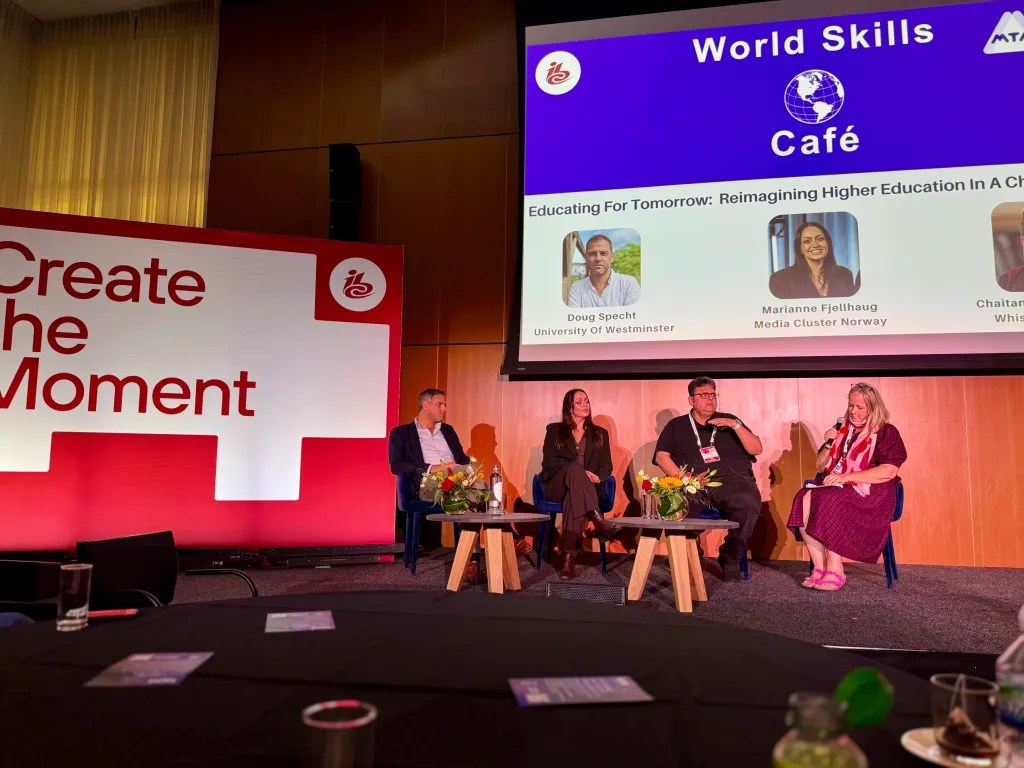
The Skills Report mentioned above was released in the The World Skills Café Conference at IBC. Organised by Media Talent Manifesto is an event bringing together the media and media tech industry to tackle the skills, diversity and workforce challenges facing our sector.
The program looked at how to strengthen career pathways into media tech as AI disrupts the industry. Companies today are multiplatform, multiskilled and multiformat, and while AI is changing jobs, it isn’t eliminating them: new roles are emerging, and the challenge is sustaining talent pipelines through the transition. Closer collaboration between industry and universities is one way forward, something many of our members are already doing well. It ensures students learn the skills the industry actually needs, gives them a clear path into the sector, and opens the door to lifelong learning.
I spoke at the conference on a panel on “Educating For Tomorrow: Reimagining Higher Education In A Changing World”, alongwith Doug Specht, University of Westminster & Marianne Fjellhaug, Media Cluster Norway, with Carrie Wooten of Media Talent Manifesto moderating the session. I spoke about how India is in the best place it has ever been for the Media & Entertainment industry with record breaking numbers for Cinema, Video Gaming, Concerts, Events, Theme Parks & Immersive Content and a big revival in OTT & Animated content. Also spoke about how Whistling Woods International students are doing fabulously well in this industry and all the work we are doing to ensure that technologically, they remain ahead of the curve. 😊👍
Then there were 3 rather interesting sessions at the Ignite Stage, Future Tech Stage:
What’s Important Right Now (WIRN) – this is an interesting structure that I have seen for the first time at IBC where they bring together a few industry leaders (forward looking voices) from varied verticals within M&E Tech to talk about what they believe is important right now across the board. Topics from Talent, AI, Skills, Sustainability and Trust were at the top of the list.
AI Won’t Make You Creative – this was also an interesting format where 2 people (both very very smart and accomplished) approached a sticky topic from two different positions and put forward their points of view. A few sparks flying apart, the session was one of the most engaging ones I attended.
FRAMES: Federated Retrieval, Agentic Media Environment and Software (Defined Workflows) An industry-first R&D solution with an intelligent, hybrid, end-to-end media framework that dissolves silos and standardizes archival asset management. By transforming archives into a structured, interoperable environment, the team’s solution utilizes Agentic AI for automated tagging, enhancement, and semantic retrieval. It also showcased a unique knowledge graph and semantic model, providing visibility into production trade-offs across soundtracks, color grading, 3D blocking, and video generation to balance creativity, time, and budget.
Personalised Sports Streaming was yet another theme which was in full force at IBC. Perfectly captured in this panel. Was very very interesting to hear all the work happening in the field…
IBC Accelerator Program – The IBC Accelerator Media Innovation Programme sits at the core of Future Tech — uniting the global media and technology community to develop practical solutions to the industry’s biggest challenges and opportunities.
Other than the above was all the stuff showcased at the 100+ booths I saw, some of which had some interesting things put out:
ADOBE – Innovations in Firefly, Graph and a closer integration of their existing Adobe Creative Cloud applications with Firefly. (Can’t say more. A lot more was disclosed by them in the Strategy roundtable that happened the day before IBC)
STYPE – AI Glue is a markerless talent tracking system designed specifically for augmented reality (AR) and virtual production. Unlike traditional motion capture setups that require actors to wear suits with retroreflective markers or carry electronic beacons, AI Glue relies entirely on AI-driven depth sensors and real image analysis to track people in real time. While it still needs the high-end hardware infrastructure of Stype, the subjects themselves can be ‘light’ without the need for suits or markers.
ARRI – ARRI Omnibar – A modular, battery-powered IP65-certified LED light bar featuring an RGBMA full-spectrum engine. Controllable through all forms of external signal control and can be used individually or jointly paired with multiple Omnibar units.
GODOX – Godox KNOWLED Lights – Godox’s professional-grade cinema and studio lighting ecosystem (including lights, control systems, accessories, etc) designed specifically for high-end film production, broadcasters, and commercial videographers. Details here – https://www.knowled.com. (If everything goes well, you will hear more news about this & Whistling Woods 😉😁 )
SIGNAPSE – It is an awesome solution for AI-enabled real-time Sign Language generation. Currently available only for US & UK, it is able to solve a much needed accessibility problem for the industry.
BRAHMA AI – Fresh from its Emmy win, Brahma AI was on full show. For those who don’t know, Brahma AI is a AI-native content creation, management, localisation company. It was formed when Prime Focus Technologies & the Gen AI company Metaphysic merged last year. Brahma does a lot of work for Hollywood and will soon be seeing displaying its prowess with multilingual dubbing for Ramayana in India..
Tiled Media – is a high-quality video streaming software – working in the VR, AR, XR & interactive multiview space. It was an output of the Dutch National Research Institute TNO – Tiled Media is today one of the best in the business catering to all kinds of sports from IPL to Formula 1. The technology core is built on top of their proprietary process where instead of broadcasting a single, massive high-resolution video file, its software splits the video stream into hundreds of smaller, synchronized “tiles” to achieve both quality & speed.
And last, but not the least – was so happy to see a Invideo booth at IBC. Desi-owned home-grown tech companies are making their mark globally so was so happy to see them.
P.S. Dropping a bunch of photos here… With no particular goal in mind… Enjoy!!!
And FINALLY, thought I should end with giving you relief from this LONG blogpost with this image – which was put up in most of the toilets of IBC – hilarious and great branding…
In the Malshej ghats near Ahmednagar, Maharashtra, there is Harishchandragadh. It is one of the few sites in India where microliths (chipped stone used as tools) used by humans between 35000BCE and 10000BCE (in the Microlithic Age) have been found.
This place has also been mentioned in the Matsyapurana, Agnipurana and Skandapurana.
On Harishchandragadh Hill, there is the Harishchandreshwar temple. Towards the right of the temple, there is the huge cave of Kedareshwar, in which there is a massive Shivling, which is completely surrounded by water. The water is generally waist-deep and is always ice-cold.
Ice-cold water seeps into this temple from all the four walls on an everyday basis. The flow of water seepage increases during the monsoons and it becomes the origin of the river Mangalganga which flows out of the temple cave & down the mountain.
As can be seen from the pictures, there is a huge rock above the Shivling. There were four pillars built around the Shivling to support the cave. 3 of these pillars are broken but the single remaining pillar continues to hold up the rock-roof.
Legend has it that each of these four pillars represent the four yugas of Krita-yuga, Treta-yuga, Dwapara-yuga and Kali-yuga and one pillar breaks off on its own at the end of each Yuga.
There is little knowledge about who built this amazing piece of architecture, engineering blending the spiritual with nature so well and managing the natural water seepage / flow from the rock so well.
Whoever did it – kudos to them. Our ancestors were great. This is another example of their genius!!!
I have been here myself as a teenager. It is as fabulous as the photos show. Whenever you get a chance, please do visit this and witness the brilliant engineering marvel.
In today’s over-sensitive world, teachers are not allowed to say or write anything negative and have to be supportive of the student always, no matter what the student does. These are a few interesting notes from teachers to parents to get their point across:
Dear Parent, We are pleased your child has one of the same qualities that Henry Ford, the founder of the Ford Motor Company, possessed. Like him, your son believes that history is best ignored. But it may be best to disabuse him of the notion that the 3 emperors of India were Amar, Akbar and Anthony. Yours beseechingly, – Teacher
Dear Parent, Your child submitted a blank paper for last week’s science test, influenced perhaps by Albert Camus who said ‘Whether the earth or the sun revolves around the other is a matter of profound indifference’. Your son shares that profound indifference, undoubtedly for philosophical reasons. But could you inform him that in order to make his mark on the global pantheon of great philosophers, he has to pass 6th grade first? Yours plaintively, – Teacher
Dear Parent, Your ward has obviously read Friedrich Nietzsche’s Beyond Good and Evil, which is why he was copying from the boy next to him during yesterday’s test. Like Nietzsche, he believes that Supermen like him have little use for conventional notions of morality. The teacher who caught him copying is a conventional type who gave him a zero. Yours desperately, – Teacher
Dear Parent, We are delighted to inform you that your child displays remarkable higher-plane-functioning. Not for him the simple-minded acts like homework. We applaud his admirable refusal to do homework. We have, however, humbly requested him to stoop to our lower-plane-functioning level and condescend to do his homework so that he may get passing grades, else he will need to remain in the same class and continue to demonstrate his higher-plane functioning to a new set of classmates next year. Your support is appreciated. Yours anxiously, – Teacher
Dear Parent, Your child’s distaste for mundane subjects such as mathematics shows an imaginative mind and great tangential thinking ability. Why, he wonders, does the square of the hypotenuse have to be equal to the square of the other two sides in a right-angled triangle? And his answers convey his indifference to such mundane realities. It is no wonder that he has scored a splendid zero in his math exam. Unfortunately, even extremely creative geniuses with brilliant tangential thinking need to pass 7th grade. Could you gently break that news to him? Yours entreatingly, – Teacher
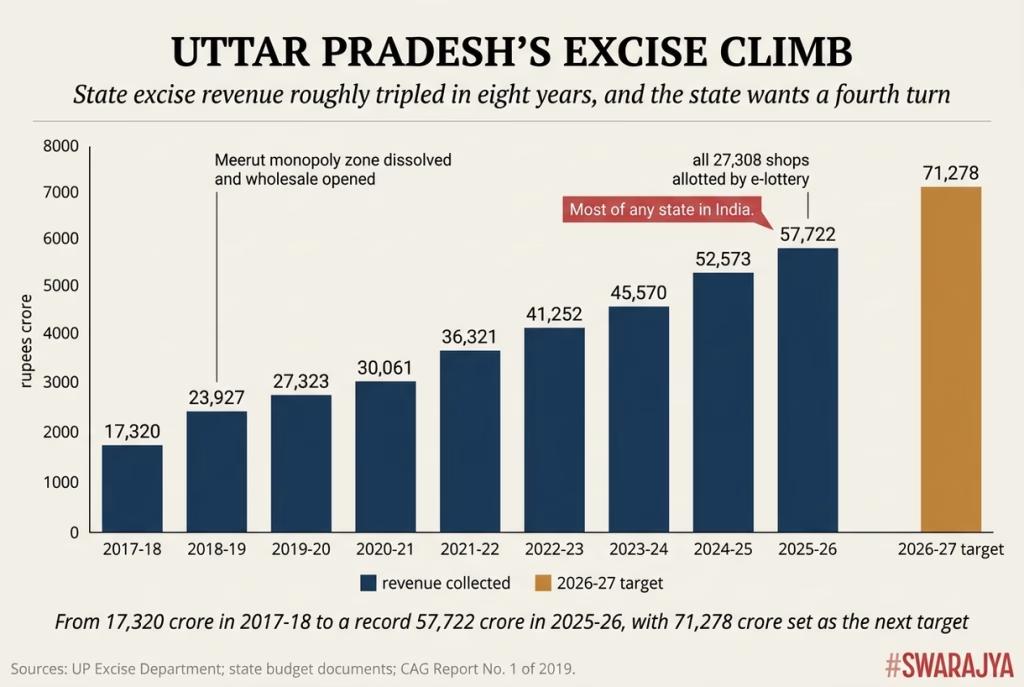
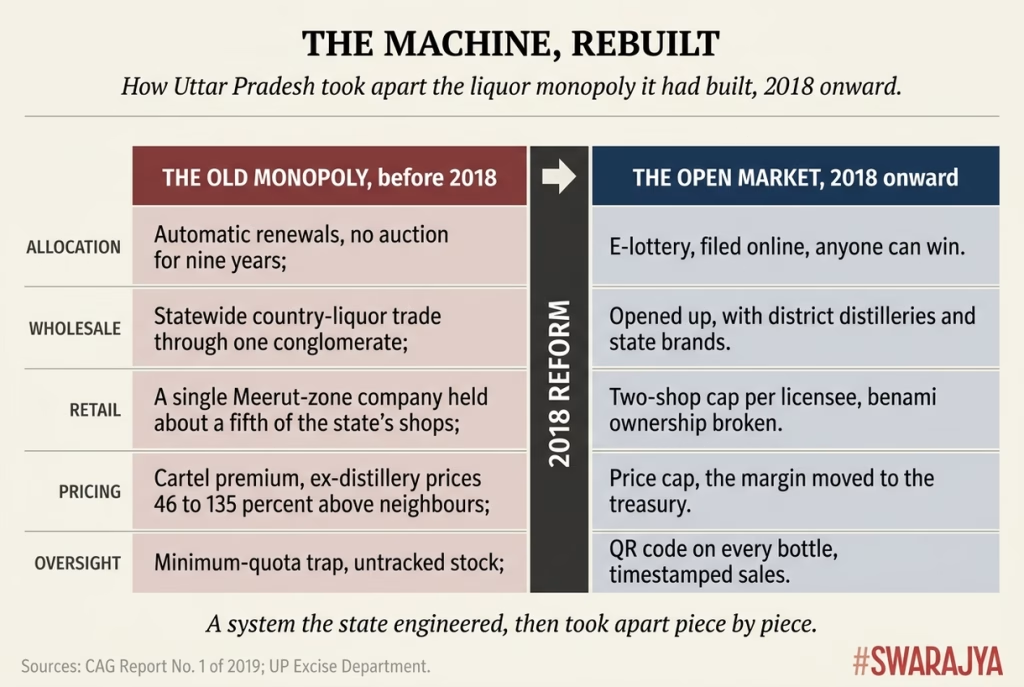
Uttar Pradesh broke the liquor cartel and brought its revenue into the state treasury. This, alongwith the streamlining and professionalisation of it’s liquor business has resulted in an incredible tripling of UP’s excise revenue in 8 yrs.
From 2009 to 2018, UP was run by a liquor policy that kept its doors closed. The country liquor wholesale of the entire state ran through one group, the Wave conglomerate of the liquor baron Ponty Chadha.
Then Yogi took things under control. Now nobody needs to approach any bureaucrat or political leader to get a licence. There is no human interaction involved. It’s the computer that decides. And each bottle is QR-code tracked from the distillery to the sales counter.
The whole liquor licensing process has become digital and transparent after Yogi Adityanath introduced a new excise policy for the state in 2018. It not only eased the lives of people but also significantly increased the excise revenue of the state.
In the first 10 months of the implementation of the new policy, a jump of 47.84 per cent was recorded in the excise revenue. A year-on-year surge of 38 per cent was observed between 2017-18 and 2018-19. The excise revenue of the state has been increasing ever since. From Rs 17,320 crore in 2017-18, it has more than tripled to Rs 57,722 crore in 2025-26, in a period of 10 years, making UP the state that earns the most revenue from excise.
Clearly, in the past, UP could not fully tap its revenue potential because a major chunk of this went to the liquor cartel before reaching the state exchequer. The state earned less, even when the customer paid more. UP’s liquor prices were more than those of its neighbours, as distilleries and breweries had set their own ex-distillery prices with almost no check for years.
Earlier, a 750 ml bottle of one common rum cost a buyer in Uttar Pradesh Rs 102.28 more than it did across the border in Rajasthan, as recorded in a CAG report. The auditor put the undue benefit to distillers, wholesalers and retailers at Rs 7,168 crore between 2008 and 2018.
The scene has changed now. Now UP fiercely competes with all its neighbours, often offering many brands at lower prices. The price change shows up at the counter. A shop which sits on the outskirts of Rampur, on the road up to Nainital, has tourists who are heading into the hills stopping to buy from the shop on the way, because liquor costs more once they cross into Uttarakhand.
Apart from taking the revenue for itself rather than the liquor cartels having it, the UP government increased its revenue through a second route by controlling the sale of illicit liquor. The state laid a track-and-trace system across the supply chain. Every bottle was QR coded to prevent any leaks between the distillery and the sales counter. It also helped excise officials to distinguish smuggled liquor from the accounted-for one.
Today, not a single bottle can be sold without scanning the QR code labelled on every label, including country liquor. This has ended the sale of illicit liquor, at least at shops. Besides restricting the sale of illicit liquor, this system also ensures that no sale is made beyond the shop timings of 10 pm or on dry days. The police action against illicit liquor has complemented the QR code initiative.
Arrests are made, and teams destroy the raw fermenting mash at remote stills along the riverbeds. In the month of May 2026 alone, some 9,900 cases were filed over illicit liquor and more than 2.29 lakh litres of it were seized. Most of what they take is untaxed or smuggled liquor. For repeat offenders, the state invokes the Gangsters Act (the UP equivalent of Maharashtra’s MCOCA). This has also ensured that the adulterated and lethal kind of liquor doesn’t reach the people. UP last saw a major hooch tragedy five years ago, when spurious liquor killed dozens in Aligarh and Azamgarh respectively in May 2021. Nothing since.
The third route by which UP increased its excise revenue is by increasing retail saturation. The state now has over 27,000 liquor shops, which has gone up slowly & steadily by a count of a few hundred every year for the past 8 years.
For 2026-27, the state has set a target of excise revenue at Rs 71,278 crore, which would require a jump of more than 23.5 per cent, more than twice the recent growth pace. To fulfil that target, the state plans to open 489 new shops across 43 districts.
And inspite increasing the number of shops, the sales of individual shops have gone up. With the reduced prices and more public confidence that the liquor they are buying in UP is not spurious, the incidence of individuals buying liquor across neighbouring state lines has crashed and nearly all of UP’s consumed liquor is now purchased in-state.
This is not the first time that UP has tried to break the liquor cartel. The first time it was done was in 2001 with the BJP in power & Rajnath Singh as Chief Minister. The 2001 policy broke the monopoly of old syndicates and opened the trade; the policy of 2009-10 under Mayawati reversed it, rebuilding the very monopoly the earlier one had ended.
The CAG, auditing the years between 2009 and 2018, found that licences had been renewed for nine years without an open auction, and that in the arbitrarily created Meerut special zone, the retail of every shop, close to a fifth of all the shops in the state, was with a single company.
In 2018, the Yogi government dissolved the Meerut special zone, opened wholesale to competition, let private players run district distilleries and sell their own brands, and moved shop allocation online. A cap of two shops per licence-holder (Aadhar & PAN linked) was put in place, which an excise official later called the change that actually worked. It broke the methodology that had let one operator hold a district through shops registered to drivers, cooks and their relatives.
The renewal system the auditor had faulted, rolled over for nine years without an open tender, was ended in 2025, when the state put all 27,308 of its liquor shops to a e-lottery. The same 2025-26 policy introduced the concept of composite shops, reducing application costs and complexities for those seeking a liquor licence. The larger shops were allowed to be upgraded into model shops to pursue premium markets, with extended timings for those in bigger cities. Earlier, there were separate licences for whisky and beer shops, and one had to apply for both separately. Now you apply for a composite shop, which gave a single licence to sell both at the cost of one form. Excise inspectors visit twice a month to check the stocks and books – and do random QR code scanning to check their authenticity.
Here’s a short chart on how the policies of UP succeeded while those of Bihar & Delhi failed. And how Andhra has learnt from UP and is currently restructuring it’s policy.
The excise revenue has now grown into a pillar of the state’s finances. Excise supplies over 20% of UP’s tax revenue, among the highest shares any major state draws from liquor, and close to a tenth of its total receipts.
Geography has also contributed to UP’s excise revenue. Bihar banned liquor in 2016, and UP’s excise revenue growth began a couple of years later, helping the state to tap into customers diverted from Bihar. Several eastern districts have become the state’s strongest earners, some out-drinking the wealthier west.
Further, as UP’s law & order got better, UP slowly & steadily widened access to liquor, permitting sale at airports, metro and railway stations, permitting sit-down drinking spaces near shops and allowing longer hours on certain occasions. The brawling and intimidation once common around shops have stopped, and no one dares start trouble now, which can be credited to the government’s readiness with the bulldozer.
The state’s near-zero liquor export is another untapped source of excise revenue. To course correct, UP launched a standalone excise export policy in 2026, becoming the first state in India to do so. This policy presents a three-year framework to cut the fees and charges on liquor made for export. It sets a nominal duty on the extra-neutral alcohol shipped out, pricing the state’s distillers to compete beyond the borders under a “Brand UP” banner. What it delivers is still to be seen.
It may sound paradoxical that the state that collects more excise than any other state in India is also the one rebuilding its temple towns of Ayodhya, Kashi and is leading the widest expansion of Hindu religious tourism ever seen in independent India. A government led by a mahant – one that has made religious tourism a central part of its political identity, now significantly funds itself through a tax that many religious people would regard as a tax on vice, and sees no contradiction in that.
This is the practical reality of government: it needs money, and this one has decided it can come from anywhere.
P.S. This content is based, almost entirely from a Swarajya article about it with the images and a lot of the text taken from that article by Nishtha Anushree.
In 1975, half a million dairy farmers in Gujarat donated two rupees each to help make a movie on their lives.
The film was called Manthan and it was directed by Shyam Benegal.
When a young Benegal went to Verghese Kurien with the idea of Manthan, he flatly refused stating that his co-operative organisation is not in the business of funding Hindi movies. But Benegal convinced him that a Hindi film would convert more farmers outside of Gujarat to join the milk cooperative movement and make it far bigger than what it currently was.
But Kurien was concerned about investing 10 lakh rupees from the co-operative on a movie and preferred that the people of the co-operative were included in the decision-making. So Benegal and Kurien came up with the idea of crowdfunding Manthan by requesting Rs.2 donation from each of the 500,000 milk farmers. The farmers were excited that a Hindi film was being made on their lives and readily agreed. Manthan raised Rs.10 lacs in less than a week.
Benegal made the film (with DoP – Govind Nihalani) in 45 days with actors like Smita Patil, Girish Karnad, Naseeruddin Shah and Amrish Puri, who lived in the villages of Gujarat like commoners.
When Manthan was released, the same 500,000 farmers and their families paid for the tickets and watched the movie in makeshift tents and single screen theatres across Gujarat making it a huge hit. Not just this, Amul took on the responsibility of distributing the film to teach more farmers about starting cooperatives, sending teams with the movie reels and projectors to 100s of villages. Millions of farmers watched Manthan and the idea of milk cooperatives spread like wildfire across India.
What is special about Manthan?
Manthan is the first-ever crowdfunded movie in India (possibly in the world). Today crowdfunding is a commonly used funding mechanism for making films, music albums and documentaries.
The film won the 1977 National Film Award for Best Feature Film in Hindi and National Film Award for Best Screenplay for Vijay Tendulkar, and was also India’s submission for the Academy Award for Best Foreign Language Film in 1976. A restored version was released in the Cannes Classics section of the 2024 Cannes Film Festival.
In May 2024, the Film Heritage Foundation did a up-res exercise on Manthan, converting it to 4K and was released in theatres.
You can also watch the film on Zee5…
Finally…
From 500,000 farmers, India today has 18 million farmers associated with milk cooperatives, supporting over 80 million rural households with jobs and incomes. Manthan was not just a film, it was a movement that led to transforming India into the largest milk producer in the world with a whopping 31% market share.
Our biggest banking win – as important as UPI – is the silent, historic turnaround of our Public Sector Banks.
A decade ago, bad loans crippled them. Today, they are healthy, modern, and just clocked a massive ₹1.78 lakh crore in net profits.
Former RBI Governor Raghuram Rajan “chocolate boy of economics” of the UPA era, noted in 2018 to a parliamentary panel that “a majority of bad loans originated in the period 2006–2008,” with too many loans going to “well-connected promoters” with a history of defaults. Promoters took on higher leverage with less equity, banks sometimes relied on promoter-linked investment-bank reports instead of independent due diligence, and public-sector banks continued financing several well-connected promoters even when private banks had already stepped away.
So what happened:
➡️ The 2015 Asset Quality Review (AQR)
The AQR finally forced banks to recognise what had been understated, restructured or evergreen for years. And once the skeletons came out of the cupboard, the numbers exploded.
The GNPA ratio of scheduled commercial banks rose from around 4.3% in March 2015 to 11.18% in March 2018, its peak. Public-sector bank NPAs rose from roughly ₹2.75 lakh crore to ₹7.33 lakh crore in about two years.
That was the past decade decade of reckless & corrupt lending gone bad, finally hitting the books.
And cleaning up that mess came with a price – lack of credit growth.
In FY17, overall credit growth fell to just 5.08%, the lowest level since 1953–54, roughly six decades. Advances to industry actually shrank in April 2017 while personal loans kept growing 14%+. Banks were happy to lend you money for a bike but wouldn’t touch a factory. Because lending to a factory is exactly the kind of loan that turns into a headline five years later.
The AQR didn’t just clean up balance sheets, it made bankers scared to sign off on anything remotely risky for years. It fundamentally changed the psychology of lending. Bankers suddenly became far more cautious about signing off on anything remotely risky. This is perhaps the most underrated cost of the banking clean-up.
And one cannot entirely blame them. Sign off on a questionable loan in 2016 and you could potentially find yourself answering questions from investigative agencies years later. The rational response for a credit officer was obvious – DON’T TAKE THE RISK. The consequence was a severe credit squeeze, particularly for industry and infrastructure, at precisely the time India needed investment to accelerate.
➡️Then came the recapitalisation.
The government first injected around ₹23,000 crore into banks in 2016. Then, in October 2017, came the much larger ₹2.11 lakh crore recapitalisation package.
This was sovereign liquidity being used to repair a banking system whose balance sheets had been damaged by years of accumulated stress.
But recapitalisation was necessary. Banks could not recognise enormous losses, provision against bad loans and simultaneously maintain adequate capital without support.
💠The key reforms behind India’s banking clean-up followed a deliberate 4R strategy (Recognition, Resolution, Recapitalisation, and Reforms), combined with supporting regulatory and recovery measures:
▪️Recognition: The 2015 AQR forced banks to recognise previously hidden or evergreened stressed assets.
▪️Resolution: The Insolvency and Bankruptcy Code (IBC), 2016 introduced a time-bound, creditor-in-control mechanism. Promoters could no longer assume that ownership was guaranteed regardless of repayment. Complementary measures included the RBI’s Prudential Framework for Resolution of Stressed Assets, strengthened SARFAESI provisions, Debt Recovery Tribunals and greater use of Asset Reconstruction Companies. Cumulative IBC recoveries have exceeded ₹4 lakh crore.
▪️Recapitalisation: The government injected substantial capital into public-sector banks, with total support across phases running into ₹3–4 lakh crore, restoring capital adequacy and enabling banks to absorb losses and eventually resume healthier lending.
▪️Reforms: PSB consolidation reduced the number of public-sector banks from 27 to 12. EASE reforms from 2018 onwards pushed improvements in risk assessment, NPA management, digital transformation, customer service, retail and MSME lending, HR and governance. Credit discipline, provisioning, asset classification and action against wilful defaulters were also strengthened.
Success came finally after 8 yrs.
The GNPA ratio of scheduled commercial banks, which had climbed to 11.18% in March 2018, fell dramatically thereafter. By March 2026, it was down to 1.8%, with net NPAs around 0.4%, a multi-decade/all-time recorded low.
Provisioning coverage remained high, often above 90%, while bank profitability recovered strongly, including record profits for public-sector banks.
India’s banking sector today is vastly healthier than it was a decade ago.
The 1.8% NPA ratio is the end product of a very expensive, very slow-moving process over years, needed to clean up the dirty reckless corrupt credit expansion and lending practices of the 2005–13 era.
August 1947. While speaking about Indian independence & the Indian freedom struggle, often times we miss talking about one woman – one of many – who lived it in blood, fire, and steel. Her name – Lakshmi Sahgal.
She was born Lakshmi Swaminathan on 24th October 1914 to Ammu & Dr. Subbarama Swaminathan, into comfort and privilege. Her father was a leading lawyer at the Madras High Court.
She could have lived an easy life. Instead, she became a doctor, earned her medical degree, and moved to Singapore, where she ran a clinic.
Then the war came, and she made a choice almost no one of her social standing made.
In 1943, Subhas Chandra Bose arrived in Singapore to build the Indian National Army, the force that would try to win India’s freedom by fighting the British from outside the country. The day Subhas Chandra Bose formed the Azad Hind Fauj, he roared: “Give me blood, and I will give you freedom.”
At his meetings, he spoke of raising a regiment of women who would fight. Not nurse. Not serve from behind the lines. Fight. Lakshmi volunteered.
She trained. She steeled her core and learnt what it was to be a soldier. Then a leader of soldiers. Seeing her abilities, Bose gave her an extremely critical mission – to lead India’s first all-women combat regiment – the Rani of Jhansi Regiment. It became the first all-women combat regiment of its kind in Asia.
Around a thousand women, many of them daughters of ordinary Indian families living in Singapore and Malaysia (many from India as well), left their homes to train under her as soldiers. Young girls, some as young as sixteen. She drilled them. Trained them. Forged them into soldiers of steel. Every day she ensured their fear dissolved into resolve. Self-doubt became courage.
Of the many broad shoulders with steely resolve that Free India stood on, was a woman who chose battle over comfort, command over safety, and service over spotlight. Lakshmi Sahgal was India’s first government’s first woman minister – the only woman in Bose’s Provisional Government.
The British sneered. “Women will break. They will flee.” They were dead wrong.
Through monsoon-soaked jungles. Across disease-ridden camps. Facing bullets, disease, and despair, Lakshmi marched. Planned. Fought. Healed. Commanded. Her soldiers called her Captain Lakshmi. The enemy called her a phantom. She kicked British ass (sorry ‘British arse’). Big time!
When the tide of the war turned and the INA began its retreat, she did not abandon her people. As both a doctor and a commander, she stayed with the wounded in the jungles and field hospitals, treating the injured through the worst of the collapse.
She was captured and brought back to India in 1946. Crowds welcomed her home as a hero.
After independance, she returned not to glory, but to service.
She married her INA compatriot – Prem Sahgal – settled in Kanpur and returned to the work that had first defined her life.
She ran a clinic, treated Partition refugees who had arrived with nothing, and continued seeing poor patients. A doctor. A reformer. A politician.
She was later awarded the Padma Vibhushan, one of India’s highest civilian honours.
In 2012, at 97, Lakshmi Sahgal passed away quietly. No national mourning. No headlines.
A woman born into privilege became a doctor to serve, a soldier to fight for her country’s freedom, and then, for the rest of her long life, a doctor once again.
Our textbooks have largely ignored her. We must not.
———————-
P.S. Capt Lakshmi’s family is an interesting one. Her sister is Mrinalini Swaminathan, who married Vikram Sarabhai & their daughter is Mallika Sarabhai. Capt Lakshmi’s daughter Subhashini was a politician & married filmmaker Muzaffar Ali (later separated). Their son is filmmaker Shaad Ali.