
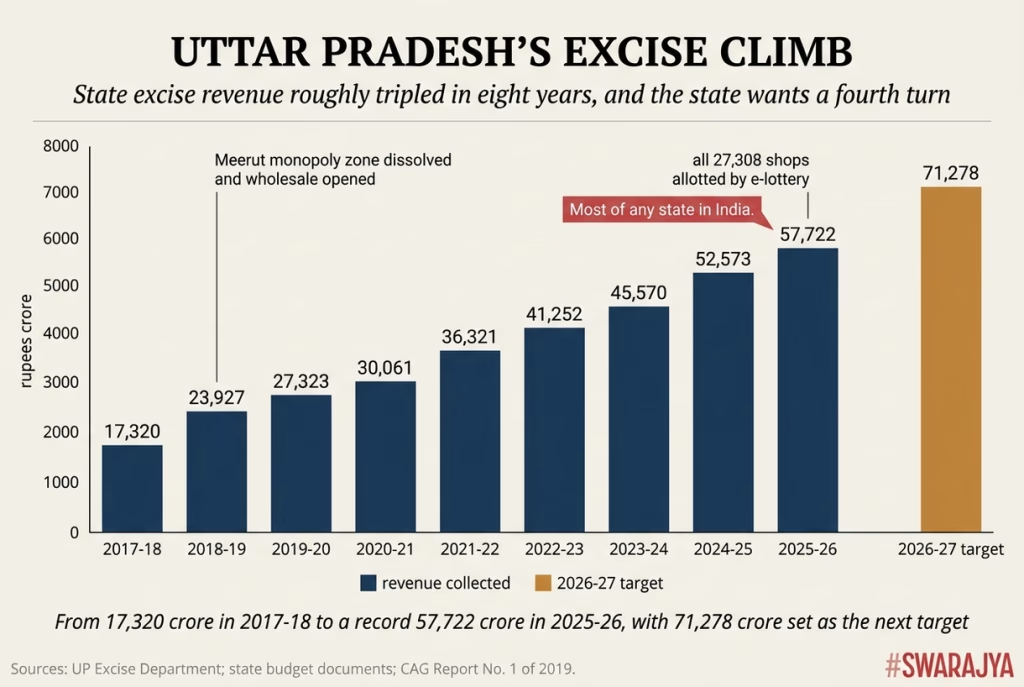
Uttar Pradesh broke the liquor cartel and brought its revenue into the state treasury. This, alongwith the streamlining and professionalisation of it’s liquor business has resulted in an incredible tripling of UP’s excise revenue in 8 yrs.
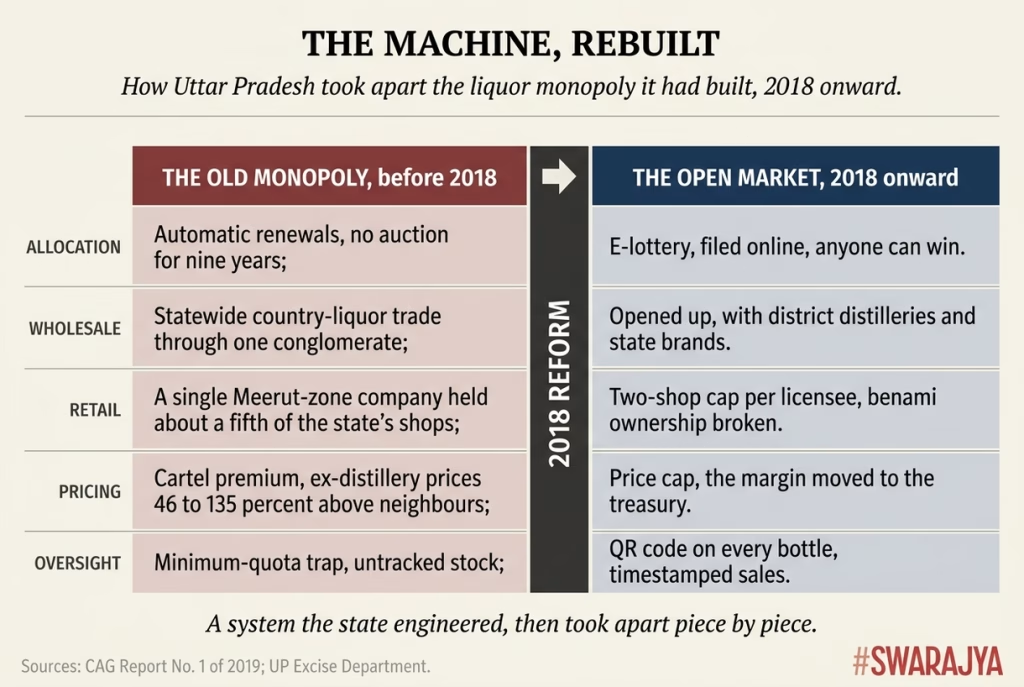
From 2009 to 2018, UP was run by a liquor policy that kept its doors closed. The country liquor wholesale of the entire state ran through one group, the Wave conglomerate of the liquor baron Ponty Chadha.
Then Yogi took things under control. Now nobody needs to approach any bureaucrat or political leader to get a licence. There is no human interaction involved. It’s the computer that decides. And each bottle is QR-code tracked from the distillery to the sales counter.
The whole liquor licensing process has become digital and transparent after Yogi Adityanath introduced a new excise policy for the state in 2018. It not only eased the lives of people but also significantly increased the excise revenue of the state.
In the first 10 months of the implementation of the new policy, a jump of 47.84 per cent was recorded in the excise revenue. A year-on-year surge of 38 per cent was observed between 2017-18 and 2018-19. The excise revenue of the state has been increasing ever since. From Rs 17,320 crore in 2017-18, it has more than tripled to Rs 57,722 crore in 2025-26, in a period of 10 years, making UP the state that earns the most revenue from excise.
Clearly, in the past, UP could not fully tap its revenue potential because a major chunk of this went to the liquor cartel before reaching the state exchequer. The state earned less, even when the customer paid more. UP’s liquor prices were more than those of its neighbours, as distilleries and breweries had set their own ex-distillery prices with almost no check for years.
Earlier, a 750 ml bottle of one common rum cost a buyer in Uttar Pradesh Rs 102.28 more than it did across the border in Rajasthan, as recorded in a CAG report. The auditor put the undue benefit to distillers, wholesalers and retailers at Rs 7,168 crore between 2008 and 2018.
The scene has changed now. Now UP fiercely competes with all its neighbours, often offering many brands at lower prices. The price change shows up at the counter. A shop which sits on the outskirts of Rampur, on the road up to Nainital, has tourists who are heading into the hills stopping to buy from the shop on the way, because liquor costs more once they cross into Uttarakhand.
Apart from taking the revenue for itself rather than the liquor cartels having it, the UP government increased its revenue through a second route by controlling the sale of illicit liquor. The state laid a track-and-trace system across the supply chain. Every bottle was QR coded to prevent any leaks between the distillery and the sales counter. It also helped excise officials to distinguish smuggled liquor from the accounted-for one.
Today, not a single bottle can be sold without scanning the QR code labelled on every label, including country liquor. This has ended the sale of illicit liquor, at least at shops. Besides restricting the sale of illicit liquor, this system also ensures that no sale is made beyond the shop timings of 10 pm or on dry days. The police action against illicit liquor has complemented the QR code initiative.
Arrests are made, and teams destroy the raw fermenting mash at remote stills along the riverbeds. In the month of May 2026 alone, some 9,900 cases were filed over illicit liquor and more than 2.29 lakh litres of it were seized. Most of what they take is untaxed or smuggled liquor. For repeat offenders, the state invokes the Gangsters Act (the UP equivalent of Maharashtra’s MCOCA). This has also ensured that the adulterated and lethal kind of liquor doesn’t reach the people. UP last saw a major hooch tragedy five years ago, when spurious liquor killed dozens in Aligarh and Azamgarh respectively in May 2021. Nothing since.
The third route by which UP increased its excise revenue is by increasing retail saturation. The state now has over 27,000 liquor shops, which has gone up slowly & steadily by a count of a few hundred every year for the past 8 years.
For 2026-27, the state has set a target of excise revenue at Rs 71,278 crore, which would require a jump of more than 23.5 per cent, more than twice the recent growth pace. To fulfil that target, the state plans to open 489 new shops across 43 districts.
And inspite increasing the number of shops, the sales of individual shops have gone up. With the reduced prices and more public confidence that the liquor they are buying in UP is not spurious, the incidence of individuals buying liquor across neighbouring state lines has crashed and nearly all of UP’s consumed liquor is now purchased in-state.
This is not the first time that UP has tried to break the liquor cartel. The first time it was done was in 2001 with the BJP in power & Rajnath Singh as Chief Minister. The 2001 policy broke the monopoly of old syndicates and opened the trade; the policy of 2009-10 under Mayawati reversed it, rebuilding the very monopoly the earlier one had ended.
The CAG, auditing the years between 2009 and 2018, found that licences had been renewed for nine years without an open auction, and that in the arbitrarily created Meerut special zone, the retail of every shop, close to a fifth of all the shops in the state, was with a single company.
In 2018, the Yogi government dissolved the Meerut special zone, opened wholesale to competition, let private players run district distilleries and sell their own brands, and moved shop allocation online. A cap of two shops per licence-holder (Aadhar & PAN linked) was put in place, which an excise official later called the change that actually worked. It broke the methodology that had let one operator hold a district through shops registered to drivers, cooks and their relatives.
The renewal system the auditor had faulted, rolled over for nine years without an open tender, was ended in 2025, when the state put all 27,308 of its liquor shops to a e-lottery. The same 2025-26 policy introduced the concept of composite shops, reducing application costs and complexities for those seeking a liquor licence. The larger shops were allowed to be upgraded into model shops to pursue premium markets, with extended timings for those in bigger cities. Earlier, there were separate licences for whisky and beer shops, and one had to apply for both separately. Now you apply for a composite shop, which gave a single licence to sell both at the cost of one form. Excise inspectors visit twice a month to check the stocks and books – and do random QR code scanning to check their authenticity.
Here’s a short chart on how the policies of UP succeeded while those of Bihar & Delhi failed. And how Andhra has learnt from UP and is currently restructuring it’s policy.

The excise revenue has now grown into a pillar of the state’s finances. Excise supplies over 20% of UP’s tax revenue, among the highest shares any major state draws from liquor, and close to a tenth of its total receipts.
Geography has also contributed to UP’s excise revenue. Bihar banned liquor in 2016, and UP’s excise revenue growth began a couple of years later, helping the state to tap into customers diverted from Bihar. Several eastern districts have become the state’s strongest earners, some out-drinking the wealthier west.
Further, as UP’s law & order got better, UP slowly & steadily widened access to liquor, permitting sale at airports, metro and railway stations, permitting sit-down drinking spaces near shops and allowing longer hours on certain occasions. The brawling and intimidation once common around shops have stopped, and no one dares start trouble now, which can be credited to the government’s readiness with the bulldozer.
The state’s near-zero liquor export is another untapped source of excise revenue. To course correct, UP launched a standalone excise export policy in 2026, becoming the first state in India to do so. This policy presents a three-year framework to cut the fees and charges on liquor made for export. It sets a nominal duty on the extra-neutral alcohol shipped out, pricing the state’s distillers to compete beyond the borders under a “Brand UP” banner. What it delivers is still to be seen.
It may sound paradoxical that the state that collects more excise than any other state in India is also the one rebuilding its temple towns of Ayodhya, Kashi and is leading the widest expansion of Hindu religious tourism ever seen in independent India. A government led by a mahant – one that has made religious tourism a central part of its political identity, now significantly funds itself through a tax that many religious people would regard as a tax on vice, and sees no contradiction in that.
This is the practical reality of government: it needs money, and this one has decided it can come from anywhere.
P.S. This content is based, almost entirely from a Swarajya article about it with the images and a lot of the text taken from that article by Nishtha Anushree.