
Each September, the Media & Entertainment Tech world converges in Amsterdam for IBC. This year too, the IBC presence was robust from the industry.
This was my 10th IBC and while the show has been up & down since Covid, this year was definitely one of the UP years. Over 50000 people showed up over a 4-day period from 11-14 September, with conferences and events happening 1 day before and 2 days after IBC.


Here’s a recap of my IBC experience.
While there are many a thing which I can absolutely not talk about (will try to drop a few hints) on account of the encyclopedia (does anyone remember what an encyclopedia is anymore?) sized NDAs I have had to sign, there are quite a few things which caught my eye.
So here goes:
My TOP find, which absolutely blew my mind, was the work Fraunhofer HHI were doing in Spatial Audio. While they have always been the research OGs of audio for decades now (they created the mp3 codec!), the work they have done in spatial audio in particular is a whole new level of COOL! Serious Mossad level / James Bond level spy stuff… WOW!!!
Rather than me trying to explain the product & the workflow, here’s a couple of videos which will do the same in a good way.
So, basically, Fraunhofer is taking serious steps to engineer the next generation of audio capture and I hope Whistling Woods is able to get involved with them in some way or the other in that journey.


Scan the QR Code above to know more about this.
A close second to this was the Sony XYN Immersive Ecosystem
Sony XYN (pronounced ‘zin’) is a comprehensive ecosystem of hardware and software for spatial content – both capture & playback. Combines immersive imaging, sensing and display technologies to capture & playback real-world spaces, objects & human movements.
Core Components of XYN:
- XYN Spatial Capture Solution – This system allows creators to capture physical environments and turn them into studio-quality background assets.
- XYN Spatial Scan Navi: A smartphone application that acts as an AR-guided navigation system. It connects to mirrorless cameras and provides a bird’s-eye preview of what has been photographed so creators don’t miss a single inch of the space.
- XYN Spatial Scan: A cloud-based web application that processes those photographs into photorealistic 3DCG models. Sony’s proprietary algorithms are uniquely tuned to render notoriously difficult surfaces like glass, reflective metals, complex shapes, and distant atmospheric lighting.
- XYN Spatial Renderer Plugin: A plugin designed to integrate and smoothly playback these massive, ultra-high-resolution assets in real-time environments, such as large-scale LED video walls.
- XYN Spatial Scan Navi: A smartphone application that acts as an AR-guided navigation system. It connects to mirrorless cameras and provides a bird’s-eye preview of what has been photographed so creators don’t miss a single inch of the space.
- XYN Motion Studio – A dedicated PC application for motion capture workflow which integrates directly with Sony’s mocopi mocap sensors and offers full timeline editing, automatic in-between animation generation (inbetweening) and cloud storage libraries.
- XYN XR Headset – A immersive spatial content creation headset features high-quality 4K OLED microdisplays and video see-through capabilities.
- SRD – The Sony Spatial Reality Display is a glasses-free 3D stereoscopic display. It works by utilising a high-precision micro-optical lens overlaying a 4K LCD panel and it projects distinct stereoscopic images to your left and right eyes simultaneously. It is the most immersive display available in the world right now.
Link – https://xyn.sony.net/en
P.S. Sorry, no photos or videos of the XYN ecosystem yet. But it will soon come. Soon. Very soon. 🙂

Now, let’s get to IBC Future Tech…
At each IBC, I spend nearly a whole day at the Future Tech Hall. And I am ALWAYS impressed with whatever I see. A lot of the interesting stuff is not actually in one of the bigger booths, but is being executed by smaller startups who showcase at the 100+ kiosks that are set up in the FutureTech Hall.


So, here’s my top 3 very interesting & cool pieces of tech I’ve seen at IBC2026 Future Tech:
- Dropstuff – very cool hybrid immersive experiences where they can create immersive content in & around real sets and create roomscale VR experiences while maintaining passthrough mode so that people are able to wear the headset & still walk around and experience immersive content. Loved it. 👏
Site – https://dropstuff.nl/ - Narrasense – Multi-sensory immersive experiences are always more impactful than not. Having seen & experienced what ARRahman has done with Le Musk, seeing that being bettered was a tough ask. But these guys have done it. Fabulous experience marrying VR with programmed scent release. Seriously, after going through their experience, I was hungry!!! 😁
Site – https://narrasense.nl/ - Livepicture AI – Real-time shadow removal for sports broadcast. I dunno about you, but I am always annoyed (mostly in football, but in tennis & cricket as well) where a big part of the playing area is under a shadow and the dynamic range of the cameras is just not able to handle it. So either you have a washed out bright area and a ok-ok shadow area or a ok-ok bright area and a completely dark shadow area. Livepicture AI fixes this in real-time. While it is in a test-enviroment as of now, hopefully I will see it being deployed soon. 👍
Site – https://livepicture.ai/


Then comes those things which were a close 2nd to these top 3:
LTX-NVIDIA – LTX builds open-weight world models that simulate physical reality, generating high-fidelity video, audio, and spatial data for video production, robotics, and real-time AI.
Site – https://ltx.io/
iFeL – is still under development (was in the Accelerator Zone) – generates high quality immersive experiences which gives the user a roomscale-VR presence in concerts and other physical events (primarily related to music but can apply to other areas too).
Site – https://show.ibc.org/accelerator-project-ifel-immersive-festival-live-remote-presence-scale


Now for all the other interesting things one saw at IBC…
A definite must-attend (and must-read) session at IBC is always the IAMT (International Association of Media Technologists) State of Media Tech Report, which they put out each year. This is based on a survey of their membership companies, which basically are almost all the companies which exist in M&E tech.
This year’s report is available on their website – https://theiamt.org/ – but I am dropping here the presentation they made at the event, which also has the QR code at the end to scan & download the full report.
Further, this year, IAMT also released their Talent Trends Report. This one focuses primarily on Europe (and a little on the US), so is not as relevant for the world as a whole, since there are quite a few things which are very inward looking, but dropping it in here all the same…
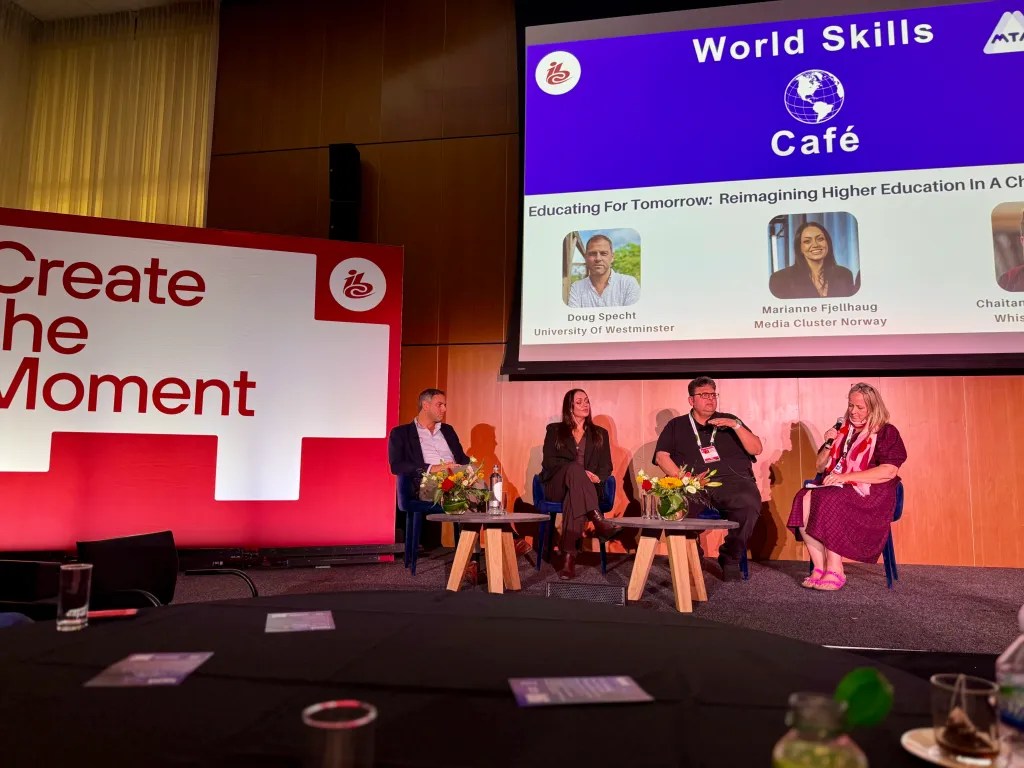
The Skills Report mentioned above was released in the The World Skills Café Conference at IBC. Organised by Media Talent Manifesto is an event bringing together the media and media tech industry to tackle the skills, diversity and workforce challenges facing our sector.
The program looked at how to strengthen career pathways into media tech as AI disrupts the industry. Companies today are multiplatform, multiskilled and multiformat, and while AI is changing jobs, it isn’t eliminating them: new roles are emerging, and the challenge is sustaining talent pipelines through the transition. Closer collaboration between industry and universities is one way forward, something many of our members are already doing well. It ensures students learn the skills the industry actually needs, gives them a clear path into the sector, and opens the door to lifelong learning.
I spoke at the conference on a panel on “Educating For Tomorrow: Reimagining Higher Education In A Changing World”, alongwith Doug Specht, University of Westminster & Marianne Fjellhaug, Media Cluster Norway, with Carrie Wooten of Media Talent Manifesto moderating the session. I spoke about how India is in the best place it has ever been for the Media & Entertainment industry with record breaking numbers for Cinema, Video Gaming, Concerts, Events, Theme Parks & Immersive Content and a big revival in OTT & Animated content. Also spoke about how Whistling Woods International students are doing fabulously well in this industry and all the work we are doing to ensure that technologically, they remain ahead of the curve. 😊👍


Then there were 3 rather interesting sessions at the Ignite Stage, Future Tech Stage:
What’s Important Right Now (WIRN) – this is an interesting structure that I have seen for the first time at IBC where they bring together a few industry leaders (forward looking voices) from varied verticals within M&E Tech to talk about what they believe is important right now across the board. Topics from Talent, AI, Skills, Sustainability and Trust were at the top of the list.
AI Won’t Make You Creative – this was also an interesting format where 2 people (both very very smart and accomplished) approached a sticky topic from two different positions and put forward their points of view. A few sparks flying apart, the session was one of the most engaging ones I attended.
FRAMES: Federated Retrieval, Agentic Media Environment and Software (Defined Workflows)
An industry-first R&D solution with an intelligent, hybrid, end-to-end media framework that dissolves silos and standardizes archival asset management. By transforming archives into a structured, interoperable environment, the team’s solution utilizes Agentic AI for automated tagging, enhancement, and semantic retrieval. It also showcased a unique knowledge graph and semantic model, providing visibility into production trade-offs across soundtracks, color grading, 3D blocking, and video generation to balance creativity, time, and budget.


Personalised Sports Streaming was yet another theme which was in full force at IBC. Perfectly captured in this panel. Was very very interesting to hear all the work happening in the field…

IBC Accelerator Program – The IBC Accelerator Media Innovation Programme sits at the core of Future Tech — uniting the global media and technology community to develop practical solutions to the industry’s biggest challenges and opportunities.
This year, there were 9 programs showcased. Details of the same are here – https://show.ibc.org/2026-accelerator-media-innovation-programme.
Booth Showcases
Other than the above was all the stuff showcased at the 100+ booths I saw, some of which had some interesting things put out:
ADOBE – Innovations in Firefly, Graph and a closer integration of their existing Adobe Creative Cloud applications with Firefly. (Can’t say more. A lot more was disclosed by them in the Strategy roundtable that happened the day before IBC)
STYPE – AI Glue is a markerless talent tracking system designed specifically for augmented reality (AR) and virtual production. Unlike traditional motion capture setups that require actors to wear suits with retroreflective markers or carry electronic beacons, AI Glue relies entirely on AI-driven depth sensors and real image analysis to track people in real time. While it still needs the high-end hardware infrastructure of Stype, the subjects themselves can be ‘light’ without the need for suits or markers.
ARRI – ARRI Omnibar – A modular, battery-powered IP65-certified LED light bar featuring an RGBMA full-spectrum engine. Controllable through all forms of external signal control and can be used individually or jointly paired with multiple Omnibar units.
GODOX – Godox KNOWLED Lights – Godox’s professional-grade cinema and studio lighting ecosystem (including lights, control systems, accessories, etc) designed specifically for high-end film production, broadcasters, and commercial videographers. Details here – https://www.knowled.com.
(If everything goes well, you will hear more news about this & Whistling Woods 😉😁 )
SIGNAPSE – It is an awesome solution for AI-enabled real-time Sign Language generation. Currently available only for US & UK, it is able to solve a much needed accessibility problem for the industry.
BRAHMA AI – Fresh from its Emmy win, Brahma AI was on full show. For those who don’t know, Brahma AI is a AI-native content creation, management, localisation company. It was formed when Prime Focus Technologies & the Gen AI company Metaphysic merged last year. Brahma does a lot of work for Hollywood and will soon be seeing displaying its prowess with multilingual dubbing for Ramayana in India..
Tiled Media – is a high-quality video streaming software – working in the VR, AR, XR & interactive multiview space. It was an output of the Dutch National Research Institute TNO – Tiled Media is today one of the best in the business catering to all kinds of sports from IPL to Formula 1. The technology core is built on top of their proprietary process where instead of broadcasting a single, massive high-resolution video file, its software splits the video stream into hundreds of smaller, synchronized “tiles” to achieve both quality & speed.
And last, but not the least – was so happy to see a Invideo booth at IBC. Desi-owned home-grown tech companies are making their mark globally so was so happy to see them.

P.S. Dropping a bunch of photos here… With no particular goal in mind… Enjoy!!!


And FINALLY, thought I should end with giving you relief from this LONG blogpost with this image – which was put up in most of the toilets of IBC – hilarious and great branding…
